
Friday the 13th: The Final Chapter

1984
Dir. Joseph Zito

Jason revives at the morgue and sets off to Crystal Lake on another killing spree. He doesn’t count on the resourcefulness of twelve year old Tommy Jarvis though.

By this stage the formula for a Friday the 13th movie had become very recognisable. Heck, one could argue the formula was recognisable since Part II! Each consecutive offering has essentially been a reworking of the one that came before it. Because of the popularity of the series thus far, producers didn’t want to deviate away from what had gone before. Therefore, The Final Chapter follows the same structure as its predecessors: Jason revives, stalks some teens who are staying at Crystal Lake – completely unaware of the danger they’re in - violently kills them one by one, until only one is left. The final survivor, usually a plucky young woman, goes head to head with Jason until he is seemingly defeated. Lather, rinse, repeat. The Final Chapter is slightly different in that it pits a family against Jason, as well as a house full of randy teens. This film also introduces us to the character of Tommy Jarvis – who would go on to be a series regular for the next couple of instalments. A twist to the usual ‘Final Girl.’


Picking up straight after events in Part III – we even see Jason’s body in the barn – continuity feels a little more considered in this film (though that’s still not saying much!). There are police helicopters everywhere in the opening scene and the film just feels ‘bigger’ than the previous ones. There does seem to be an attempt to tie everything together and bring it to a head. There’s even a glimpse of Mrs Voorhees’ grave early on, talk of ‘the old legend of Jason’ and newspaper headlines about the previous killings. It would seem that since events in Part II, only a few days have passed until events in Part IV kick off. When his body is brought to the morgue, there is a feeling that this might become a hospital-set slasher in the same vein as Halloween II, Phobia or Visiting Hours. Alas, this is not to be the case – after he slaughters a morgue attendant and a nurse, Jason heads straight back to his old familiar stomping ground of Crystal Lake. Just how big is this fucking lake?

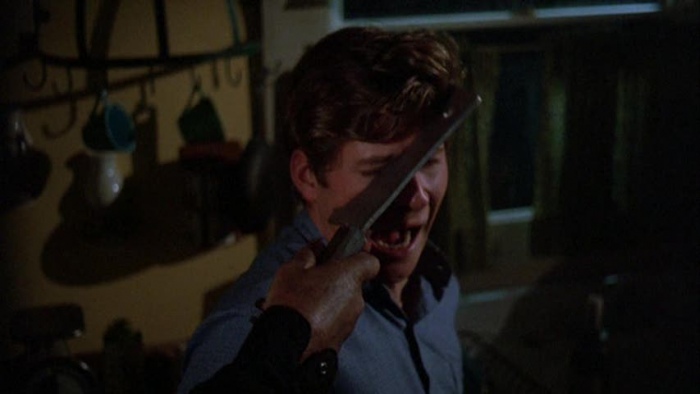
With the introduction of the Jarvis family – mother Mrs Jarvis (Joan Freeman), daughter Trish (Kimberly Beck), young son Tommy (Corey Feldman) and family dog Gordon – this film features a loving family at its heart; a nice break from the usual randy teens. But wait! Before you can think to yourself ‘what kind of body count is this?!’ the house next to the Jarvis’ lakeside abode is rented by a car load of teens – including Peter Barton (Hell Night) and Crispin Glover - ready to party! As the teens hang out, skinny dip, befriend a couple of local twin sisters and debate whether or not Jimmy (Crispin Glover) is a ‘dead fuck’, Jason stalks their every move, waiting until nightfall before offing them one by one. As before, a number of moments from previous films are reproduced – more bodies chucked through windows, creepy business involving bodies on boats and cod-psychology used to stop Jason in his tracks – like Ginny Fields (Part II) before him, Tommy makes Jason think of his childhood and mother. The boy shaves his own head to replicate Jason's appearance as a young boy thought drowned all those years ago. Surprisingly enough, it works. For a while.


The characters in this are a little more fleshed out than previous ones - some of them are actually likable - and the humour is as intentional, though much less overt than Part III. Crispin Glover’s impromptu dance is a particular highlight. The stakes are raised higher and director Zito (who had previously directed the supremely creepy slasher The Prowler) manages to ensure the chase scenes at the end maintain a high level of suspense. A few expectations are subverted along the way – for example the death of Rob. It’s revealed that he has hiked into the area to seek vengeance for the murder of his sister Sandra (who was murdered in Part II). One would assume that he’ll come to the rescue of the family. He doesn’t. Another sly variation on slasher clichĂ©s is that a pretty young man (Peter Barton) is killed while taking a shower, not a pretty young woman.


The Final Chapter was intended to be, well, funnily enough, the last instalment of the series. Slasher movies were on the way out by 1984, and Paramount wanted to give Jason a bravura send-off. As such, original special effects guru Tom Savini – whose work helped make the original Friday the 13th so memorable and gory – was enticed back with the allure of killing off Jason for the last time. Of course, the kills and the splashy effects of the series have pretty much been its calling card, but there was just something about the ones featured in the first film that made them stand out. Savini’s work has stood the test of time and several of those kills still remain brutally effective. Part IV features more impalements, machetes to the face, heads crushed against walls, axes to chests, corkscrews stuck into hands and even boasts the gruesome sight of a machete sliding through Jason’s head when Tommy impales him with it. And while this was supposed to be the final film (oh, who’s kidding who here?), the denouement is still fairly downbeat, with the implication that Tommy has been traumatised enough so as to have sinister implications on his mental state. The look he flashes the camera - which also becomes the film’s closing shot - suggests he could take on Jason’s persona and continue the Crystal Lake killing spree.


One of the better sequels, and had the series ended here, it would have provided a decent send off.

Popular posts from this blog

The Ash Tree

1975 Dir. Lawrence Gordon Clark Part of the BBC’s annual series A Ghost Story for Christmas , which ran from 1971 to 1978 and featured some of the small screen’s most chilling moments, The Ash Tree was the last of several MR James adaptations directed by Lawrence Gordon Clark. Written for television by David Rudkin, It stars Edward Petherbridge in the dual role of Sir Richard, an 18th century aristocrat who inherits the vast estate of his late uncle, and of Sir Matthew, his 17th century ancestor whose role in local witch trials, and the death of Ann Mothersole (Barbara Ewing), haunts Sir Richard.  With a slim running time (just over 30 minutes) The Ash Tree is one of the shortest entries in the series, but it is also one of the densest. The amount of detail and information packed in, without compromising or diluting the impact of the source material, is admirable. Clarke manages to convey events and flashbacks by utilising an interesting narrative structure and some ...

Mandrake (2022)

Mandrake tells of probation officer Cathy Madden (Deirdre Mullins), who is assigned to help with the rehabilitation of recently released ‘Bloody’ Mary Laidlaw (Derbhle Crotty), who had been incarcerated years prior for the murder of her abusive husband. Rumours have long swirled in the local area concerning Mary’s dabbling in witchcraft and involvement in cases of missing children. No sooner has she been released, than the bodies of several local children are found in the woods near her farmhouse. As Cathy and local police delve deeper, the veil between real and imagined starts to fray and Cathy is drawn into a dark world of occult ritualism and blood sacrifice. Directed by Lynne Davison and written by Matt Harvey, Mandrake is a delicious slice of witchy, Northern Irish folk horror, dripping with atmosphere and arcane lore. While Irish horror is having a moment right now, with acclaimed titles such as Aislinn Clarke’s FrĂ©waka and Kate Dolan’s You Are Not My Mother mining rich and cr...

Kensal Green Cemetery

During a recent visit to London, a friend and I decided to explore Kensal Green Cemetery in the west of the city. Founded as the General Cemetery of All Souls by barrister George Frederick Carden in 1833, Kensal Green was inspired by the garden-style cemetery of Pere-Lachaises in Paris. Comprised of 72 acres of beautiful grounds, it was not only the first commercial cemetery in London, but also the first of the ‘Magnificent Seven’ garden-style cemeteries established to house the dead of an ever-increasing population. Campaigners for burial reform were in favour of “detached cemeteries for the metropolis” and in 1832 Parliament passed a bill that led to the formation of the General Cemetery Company to oversee appropriate measures and procedures concerning “the interment of the dead.” The company purchased land for the establishment of Kensal Green in 1831 and held a competition in order to select an appropriate designer. Among the prerequisites in the brief provided to entrants, we...