Posts

Showing posts with the label Essay

Red Hoods, Dark Woods Part IV: Happily Ever After

Image
'Snow, Glass, Apples' by Julie Dillon With filmmakers like Catherine Hardwicke directing modernised fairy tales for teen horror audiences, it is safe to assume that more will soon follow – think of what Twilight did for romanticising vampires and making them appealing to teen audiences. Love it or loathe it, its influence on popular culture is undeniable. Fans of Twilight no doubt flocked to Hardwicke’s latest offering. A number of Hollywood horror-tinged adaptations of fairy tales are actually already in the works. Amongst them is the Julia Roberts starring Mirror Mirror , with Roberts tipped to play the Evil Queen. Directed by Tarsem Singh ( The Cell ), the film is a dark twist on the classic fairy tale, in which Snow White and the seven dwarfs look to reclaim their destroyed kingdom. Another film that refigures the tale of Snow White, with Snow White leading the charge into battle, is Snow White and the Huntsman , starring Kristen Stewart as Snow White, and Chris Hem...

Red Hoods, Dark Woods Part III: The Beast Within…

Image
With its central image of a young woman being stalked and menaced through a dark and foreboding forest by a sly and slathering beast, Red Riding Hood has always had its roots firmly planted in horror. Later literary adaptations of the folk story, by the likes of Charles Perrault and the Brothers Grimm, demonstrate a harsh conservative morality akin to many horror films (particularly certain 80s slasher films) warning of what happens to young people who ‘stray from the path’ and let their curiosity get the better of them. It is essentially a dark tale about rite of passage and crossing the threshold from childhood to adulthood. The forest, a place used time and again in literature and cinema to represent a place of hidden danger, primal fear and dark threat (but also, interestingly, freedom from the restraint and pressures of conservative society) serves as the suitable backdrop; a place that is as far removed from civilisation as possible. What further embeds the tale in horror is...

Red Hoods, Dark Woods Part II: Once Upon A Time…

Image
Throughout the years many filmmakers have adapted various versions of Little Red Riding Hood for cinema, most to investigate or exploit its coming of age subtext. In the early Eighties Irish filmmaker Neil Jordan collaborated with English writer and novelist Angela Carter on an adaptation of her book 'The Bloody Chamber.' 'The Bloody Chamber' is a collection of fairy tales, including Little Red Riding Hood, which Carter had reworked, reinterpreted and filtered through a 20th Century feminist viewpoint to give them a fresh and provocative perspective. Their resulting collaboration was 1984’s strikingly beautiful and dreamlike The Company of Wolves , a film that unfurls as the fever-dream of a young woman experiencing menstruation for the first time. Boasting a narrative of stories within stories and dreams within dreams, The Company of Wolves retains its haunting power even now, with its rich and intoxicating atmospherics. Angela Lansbury starred as the Grandmother w...

Red Hoods, Dark Woods Part I

Image
"The Company of Wolves II" by Olukemi With Snow White and the Huntsman galloping onto screens in the wake of, and from the same gothic fairy tale stable as Catherine Hardwicke’s Red Riding Hood , and Tarsem Singh’s Mirror Mirror to follow soon after, it looks like fairy tale adaptations are trending at the moment. They’re certainly not a new thing; fairy tales have often provided the basis for films throughout cinema history – either directly or loosely. I thought it might be interesting throughout the course of December to have a look at one of the most recognisable and enduring of these tales – Little Red Riding Hood. The tale of Little Red Riding Hood is centuries old. Most people will be familiar with it thanks to growing up with the likes of the slightly diluted version by the Brothers Grimm, in which a young girl and her grandmother are rescued from the belly of a ravenous wolf by a chivalrous woodsman. Earlier versions of the tale were much darker, and bleaker....

There’s Something About Fulci…

Image
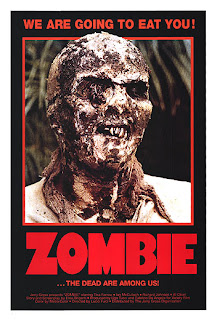
When I began to flesh out my thoughts and hastily scribbled notes on The Black Cat , I ended up spewing forth a tangent about why I find Lucio Fulci’s film work so disturbing, horrifying and repellent. Below is said tangent, and the review of The Black Cat (tangent free) can be found here .  Of the countless schlocky, ultra-violent, exploitation-laden fare this writer has watched over the years - and the plethora of disturbing, mind-numbingly deplorable and brain-botheringly wretched imagery I’ve witnessed as a result of watching such fare - one filmmaker and his work stands apart from the others when it comes to creating genuinely upsetting, avert-your-gaze-from-the-screen-in-disgust moments. Lucio Fulci is a director most fans of horror cinema will be familiar with. Heck, many of them will even own some of his work on DVD or something called VHS. My own experience of watching Fulci’s work is quite limited. I find his films to be disturbing, disgusting and weirdly depressing...

'It's Coming For Me Through The Trees': Kate Bush & Gothic Horror

Image
There are few other creative figures of a more distinct, visionary and idiosyncratic nature to have emerged from the music industry in the twentieth century, than that of Kate Bush. Not only is she an artist who has accomplished the rare feat of combining musical innovation with commercial success, but she is one who also managed to do so on her own terms, whilst maintaining complete creative control of her work. Bush, in the words of one critic, ‘got all the madwomen down from the attic and into the charts.’ She is heavily inspired by the world of art, philosophy, literature and indeed cinema, drawing upon an almost encyclopaedic array of influences. When one takes a closer look at her work, it becomes apparent that Bush is something of a horror aficionado, drawing on a number of sources to lend her compositions rich, blood-dark depth. Out on the wiley, windy moors. ‘Wuthering Heights’ was a Gothic novel by Emily Brontë in which the conventions of the Gothic novel were refl...

The Dark Art Of Seduction: Femme Fatales From Noir To Horror, And Back*

Image
'Your hand, your tongue, Look like the innocent flower, but be the serpent under 't.' - Lady Macbeth 'Appearances are deceptive.' - Aesop One of cinema's most compelling stock characters is the ‘femme fatale’ – a complex, seductive and dangerous woman whose cunning can sometimes belie her need for justice or vengeance, her rage, or a wounded heart, or sometimes just demonstrate her bitter cruelty. Less often, her motives were completely concealed from the viewer. She ensnares her lovers through sexual conquest, often leading them into compromising and deadly situations. ‘Femme fatale’ is French for ‘deadly woman’. Quite often these women were portrayed as somehow wronged and whose vengeance decimates all those who have wronged them. An archetypal character of literature, cinema and even art, the femme fatale is most frequently associated with Film Noir. Film Noir is a cinematic term used to describe stylish Hollywood crime dramas – extremely popular th...