Posts

Showing posts with the label Female Werewolves

Ginger Snaps Back: The Beginning (2004)

Image
1815. Ginger and Brigitte Fitzgerald, two orphaned teenaged sisters, seek refuge at an isolated trading fort in the snowy Canadian wilderness. They soon learn that the fort is under siege from werewolves lurking in the surrounding woods. After Ginger (Katharine Isabelle) is attacked and bitten by the lycanthropic son of the fort's factor, she begins to change. Her sister Brigitte (Emily Perkins) seeks a cure while trying to keep them both safe from the men in the fort, whose mistrust of the sisters is stoked by a bloodthirsty, wrathful minister. Directed by Grant Harvey, Ginger Snaps Back is a period piece (no pun intended) and a prequel to Ginger Snaps (2000), the story of a young woman who, on the night she first menstruates, is attacked by a werewolf and begins to transform into a monster. It was followed by  Ginger Snaps Unleashed (2004), which follows the plight of Ginger's sister, Brigitte, as she struggles to find a cure for her own latent lycanthropy. Written by Chr...
The Company of Wolves (1984)

Image
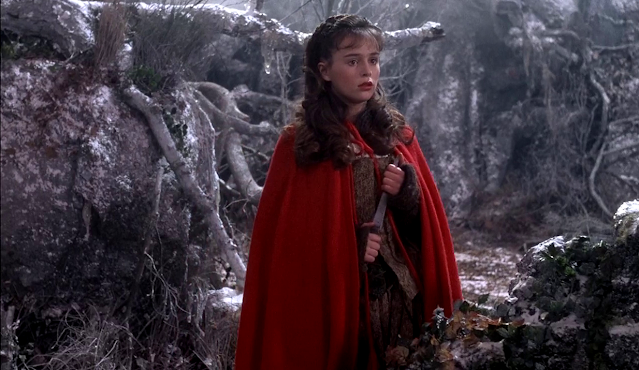
Co-written by Irish filmmaker Neil Jordan and British novelist Angela Carter, and based on several short stories from her collection, The Bloody Chamber , The Company of Wolves is a werewolf film quite unlike any other. A provocative reinterpretation of the fairy tale of Red Riding Hood, it unravels as a feverish exploration of a young girl’s sexuality as she crosses the threshold into adulthood. It was Jordan’s second film, and his first foray into the realms of Gothic horror. Entwining metaphor with striking visuals and grisly effects, The Company of Wolves was released in the early Eighties, in the wake of The Howling and An American Werewolf in London ; it set itself apart from the pack, however, with its literary roots, feminist concerns and art-house execution. The folk tales it draws upon and the significance of oral storytelling itself are woven into the very fabric of the film. Its unusual narrative structure, which unfurls like a Chinese puzzle box, begins as a young girl,...

Conversations About Wolves: Dr Hannah Priest

Image
When I was researching my book on The Company of Wolves , I reached out to author, lecturer and historian, Dr Hannah Priest. Dr Priest is the editor of She-Wolf: A Cultural History of Female Werewolves (2015, Manchester University Press), a collection of academic essays on the history of female werewolves. We exchanged a few emails and she very kindly shared her thoughts on The Company of Wolves with me. Unfortunately, I wasn’t able to include all of Hannah’s thoughts in my book (thanks to a pesky wordcount), so I wanted to share them here… On The Company of Wolves and how it presents the figure of the female werewolf : For me, The Company of Wolves is very much of its time, both in terms of style and message. However, as far as female werewolves go, I think there's a case for arguing that it was very influential on later texts (or, perhaps, on ideas more generally). The relationship between female werewolves and sexuality is really cemented in the 19th century, though there are ...

Conversations About Wolves: Suzy McKee Charnas

Image
While conducting research for my forthcoming monograph on Neil Jordan’s The Company of Wolves , I had the pleasure of conversing with science-fiction and fantasy author Suzy McKee Charnas. Back in the late eighties Suzy wrote an award-winning short story called ‘Boobs’, which not only shares strong affinities with The Company of Wolves , but also preceded the thematically similar Ginger Snaps (2000) by over a decade. Like these titles, ‘Boobs’ connects the ambivalent figure of the adolescent girl, fluctuating between childhood and adulthood, with the figure of the werewolf, which fluctuates between human and beast, and draws parallels between menstruation, developing sexual identity and desire, and the unleashing of something wild. It tells of Kelsey, a shy and lonely teenager whose menarche coincides with her transformation into a wolf. She uses her new-found power and abilities to take revenge on a bully who has made her life a living hell and whose cruel nickname for Kelsey, due...

The Werewolf

Image
Artwork by Jim Perez 1913 Dir. Henry MacRae A Navajo witch-woman believes her husband has deserted her, but unbeknownst to her, he has actually been killed. When she is rejected by his family, she raises her daughter to hate all white men. The daughter grows up to become a werewolf and she seeks revenge on those who killed her father and wronged her mother. While now believed to be a lost film, destroyed in a fire in 1924, The Werewolf is thought to hold the honour of being the first ever werewolf film. It also marks the first cinematic appearance of the female werewolf, a figure who, until relatively recently, was often overlooked (in cinema) in favour of her male counterpart. Interestingly, The Werewolf can also be seen (perhaps rather tenuously) as the first Universal horror film, though at the time, the distributor was still known as the Universal Film Manufacturing Company. It was directed by Canadian filmmaker Henry MacRae, who, amongst other things, is credited as ...