Posts

Showing posts with the label Film Criticism

Book Update: Review by Emily Turner

Image
The latest review of my Devil’s Advocates book on The Company of Wolves comes courtesy of journalist and academic, Emily Turner. According to Turner, ' Gracey is adept at identifying key themes in the 1984 film and exploring them in an accessible but thorough manner, forging links between images and ideas, and wider theoretical concepts [...]  a useful and interesting overview of the myriad references and inspirations which conjured the film from the minds of Jordan and Carter.' I’ve copied the full review below, and you can also check it out over at Emily’s blog ... Cinematic lycanthropy and monstrous femininity: a review of James Gracey’s The Company of Wolves  By Emily Turner The Company of Wolves is a title in Auteur Publishing’s Devil’s Advocate series, which showcases a range of critical approaches to horror cinema. James Gracey’s text explores how the 1984 Neil Jordan film of the same name evokes fairy tales, horror, werewolf films, Freudian symbolism, and t...

Book Update: Film International Review

Image
The latest review of my Devil’s Advocates book on The Company of Wolves comes courtesy of Jeremy Carr over at Film International , and it’s another really positive one. According to Carr, 'Gracey does his part to add to the legacy of The Company of Wolves, strengthening the film’s importance with a thoughtful monograph that is detailed and accessible, presenting arguments with deliberation and validity, never forcefully or self-righteous. Jordan’s film isn’t perfect by any means, but Gracey’s ultimate achievement is in making the case that it still warrants and welcomes further examination.' I’ve copied the full review below, and you can also check it out (along with a wealth of other film related reviews, news and features) over at Film International ... Review (by Jeremy Carr) James Gracey’s Devil’s Advocates entry on The Company of Wolves (Auteur Publishing, 2017) does everything a book of its scope should do. In about 120 pages, Gracey takes what is a generally...

Women in Horror Annual

Image
Edited by Paracinema Magazine co-founder and former editor, Christine Makepeace , and C. Rachel Katz , the Women in Horror Annual (WHA) is a collection of horror fiction and nonfiction written by women. The WHA counts as one among a scant handful of women-only anthologies in the horror literature landscape. The annual promotes and celebrates women's voices in horror, and the stories and papers contained within - penned by new and emerging literary talent - represent a diverse group of writers, each with their own unique vision and voice. Some of these writers have published previously, while others are just starting out. Women's voices can be under-represented in horror, and this anthology is another step towards providing them with the opportunity to be heard/read. The nineteen original stories featured in the annual run the gamut from melancholic to erotic; some are violent, brutal affairs, and others are more psychological. The essays include cinematic and literary a...

Shocks to the System

Image
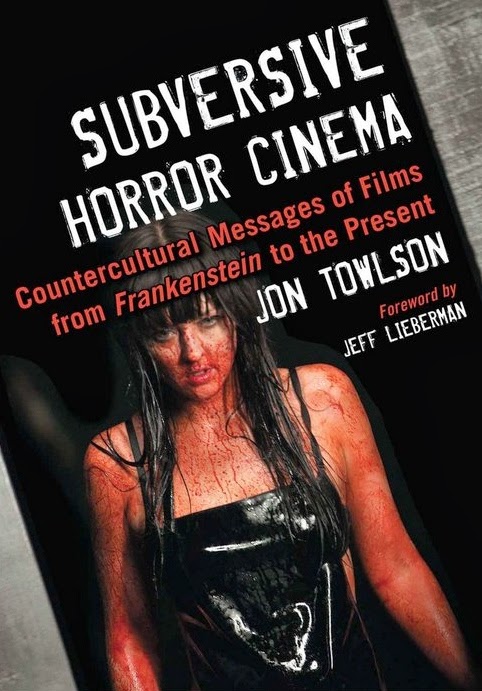
" Obviously what's happening in the world creeps into any work, it just fits right in. Because that's where it comes from, where the idea comes from, where you get the idea in the first place ." George A. Romero Horror cinema flourishes in times of ideological crisis and national trauma - the Great Depression, the Cold War, the Vietnam era, post-9/11. Subversive Horror Cinema: Countercultural Messages of Films from Frankenstein to the Present , a brand new book by Jon Towlson, argues that a succession of filmmakers working in horror - from James Whale to twisted twins Jen and Sylvia Soska - have used the genre, and the shock value it affords, to challenge the dominant ideologies of these times. Spanning the decades from the 1930s onwards, Subversive Horror Cinema is a critical examination of the work of producers and directors as varied as George A. Romero, Pete Walker, Michael Reeves, Herman Cohen, Wes Craven and Brian Yuzna - and the ways in which films like...