Posts

Showing posts with the label Silent Film

The Werewolf

Image
Artwork by Jim Perez 1913 Dir. Henry MacRae A Navajo witch-woman believes her husband has deserted her, but unbeknownst to her, he has actually been killed. When she is rejected by his family, she raises her daughter to hate all white men. The daughter grows up to become a werewolf and she seeks revenge on those who killed her father and wronged her mother. While now believed to be a lost film, destroyed in a fire in 1924, The Werewolf is thought to hold the honour of being the first ever werewolf film. It also marks the first cinematic appearance of the female werewolf, a figure who, until relatively recently, was often overlooked (in cinema) in favour of her male counterpart. Interestingly, The Werewolf can also be seen (perhaps rather tenuously) as the first Universal horror film, though at the time, the distributor was still known as the Universal Film Manufacturing Company. It was directed by Canadian filmmaker Henry MacRae, who, amongst other things, is credited as ...
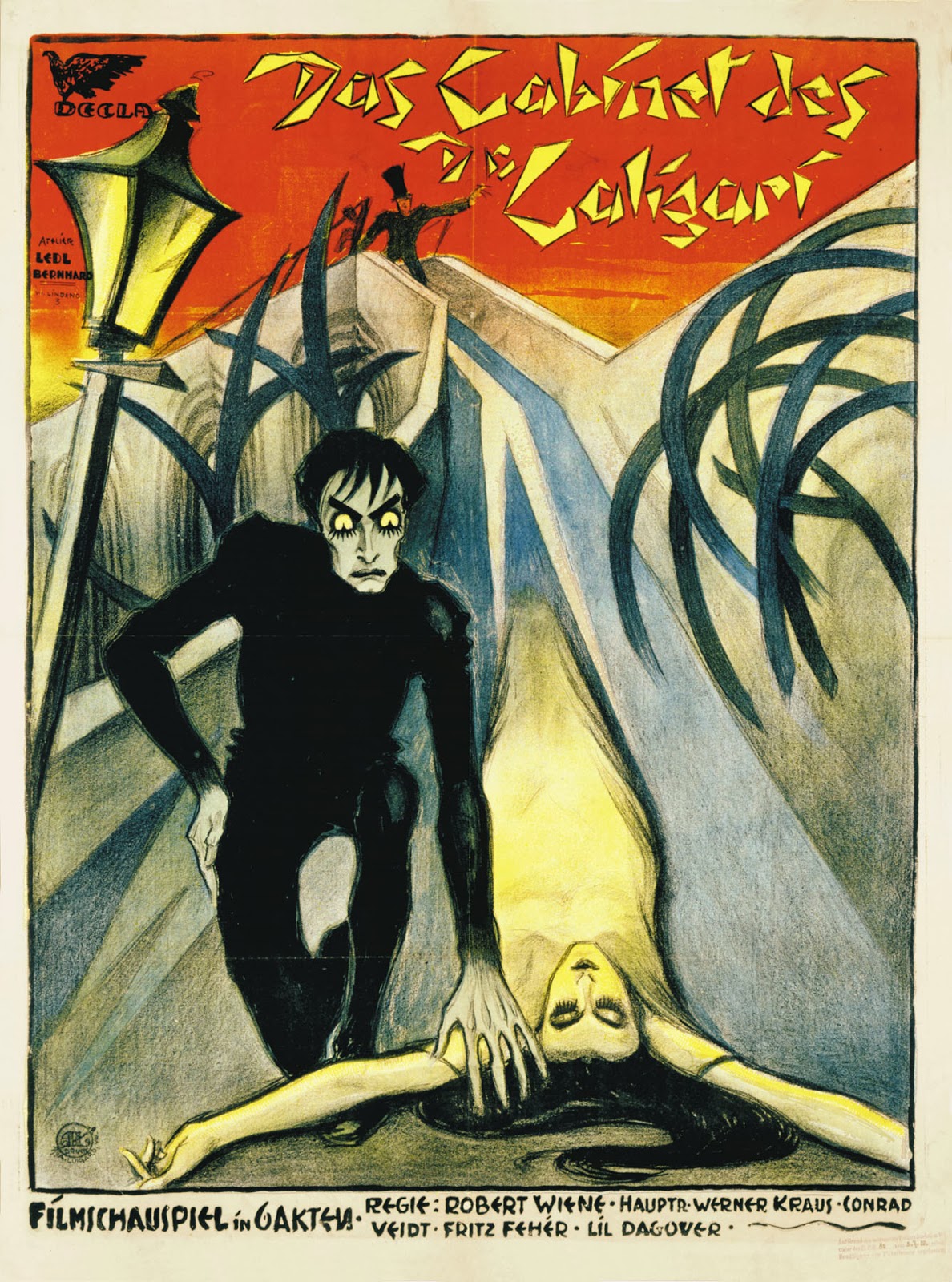
An Appointment with Dr Caligari

Image
Last night Belfast’s The Crescent Arts Centre played host to a very special screening of the classic German horror title, The Cabinet of Dr. Caligari , complete with a live score courtesy of Dublin based instrumental ensemble, 3epkano. Formed in 2004 by Matthew Nolan and Cameron Doyle, 3epkano, pronounced three-ep-can-oh, which derives from Andrei Tarkovsky's film Зеркало ( The Mirror ), specialise in composing and performing contemporary soundtracks for classic films from the silent era of cinema. Spirits surround us on every side... they have driven me from hearth and home, from wife and child. Made in 1920, The Cabinet of Dr Caligari was written by Hans Janowitz and Carl Mayer. Now considered one of the most influential films of the German Expressionist movement, and indeed of horror cinema, it tells of the sinister Caligari, a mad carnival performer who uses a cadaverous somnambulist to carry out his nefarious deeds, including manipulation, murder and kidnap… Oh my! Beg...

The Call of Cthulhu

Image
2005 Dir. Andrew Leman "The most merciful thing in the world, I think, is the inability of the human mind to correlate all its contents. We live on a placid island of ignorance in the midst of black seas of infinity, and it was not meant that we should voyage far. The sciences, each straining in its own direction, have hitherto harmed us little; but some day the piecing together of dissociated knowledge will open up such terrifying vistas of reality, and of our frightful position therein, that we shall either go mad from the revelation or flee from the light into the peace and safety of a new dark age." H.P. Lovecraft First published in Weird Tales in 1922, Lovecraft’s The Call of Cthulhu concerns Francis Wayland Thurston, a young man who is attempting to piece together the circumstances of his great-uncle's death. While looking through the dead man’s possessions he finds a weird manuscript pertaining to an ancient and alien slumbering deity, and the despicable ...

An Evening With Nosferatu At The Ulster Hall: 1920's Style

Image
Last night in Belfast, the Ulster Hall hosted a very special screening of FW Murnau’s undisputed classic of German Expressionist cinema, Nosferatu . The film was accompanied by an improvised score courtesy of renowned organist, Martin Baker, who has, since 2000, been the Master of Music at Westminster Cathedral. Baker was granted the rare honour of being allowed to play the world famous Mulholland Grand Organ, one of the oldest examples of a functioning classic English pipe organ. The organ is named after former Lord Mayor of Belfast, Andrew Mulholland, who donated it to the hall in the 1860s. Patrons of the sold-out event were encouraged to dress in typical 1920s garb and though many didn’t, this writer was impressed by those who did; particularly an enthusiastic couple dressed as the undead. Before the screening, there was an insightful introduction by local film historian, opera fanatic and all round film buff, George Fleeton, who lovingly dissected the historical significa...