Posts

Showing posts with the label Werewolf

Wolf Man (2025)

Image
Directed by Leigh Whannell, Wolf Man is a reboot of the 1940s classic The Wolf Man , starring Lon Chaney Jr. It tells of a family stranded at a remote forest cabin who are attacked by a werewolf. As it prowls around outside the cabin, they face another deadly threat from within, as the wounded father begins to transform into a slathering beast...  Throughout folklore, literature and cinema, the figure of the werewolf has been used to explore ideas of mankind's innate savagery; the unleashing of an inner beast, primitive, instinctual, stripped of logic and reason, unshackled from centuries of civilisation and societal conformity. Many of the conventions of the werewolf film were established by Hollywood films: the use of silver to destroy the werewolf, the influence of the full moon on transformation, and the contagious nature of lycanthropy. Aside from the latter, Whannell's film dispenses with these conventions and attempts to establish a sense of realism. While the screenpla...
The Cursed (2022)

Image
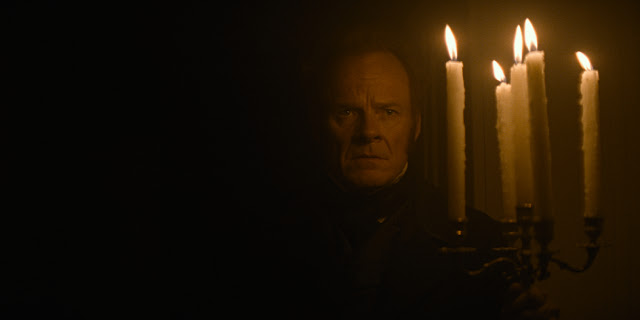
With a truly uncommon approach to the figure of the werewolf, The Cursed is a mean and moody shocker with a haunting, weirdly lyrical undertow. After their father, a cold-hearted land baron, ruthlessly slaughters a camp of Romani who staked a claim to his land, young Charlotte and Edward begin to have ominous dreams of a human scarecrow and silver teeth. The dreams draw them and other children from the nearby village to the site of the massacre, and soon after, Edward goes missing. The discovery of grisly remains attracts the attention of a grief-stricken pathologist (Boyd Holbrook), who suspects something supernatural is lurking in the surrounding forest and vows to hunt it down and destroy it. Head over to Eye for Film to read my full review. 

Werewolf of London

Image
1935 Dir. Stuart Walker While travelling through Tibet in search of a mysterious flower that only blooms in moonlight, renowned botanist Dr. Wilfred Glendon (Henry Hull) is attacked by a werewolf. When he returns to London, Glendon begins to undergo a terrifying transformation, the only antidote for which appears to be the plant he is researching... Produced by Universal in the wake of the success of Dracula, Frankenstein and The Mummy , Werewolf of London was the first mainstream Hollywood werewolf film. It established several precedents which later became significant mainstays of werewolf cinema, such as the idea of lycanthropy as a contagious disease, the influence of the full moon on the werewolf’s transformation, and the spiritual torment suffered by the tragic male protagonist as he desperately attempts to find a cure for his monstrous condition. As the eponymous beast, Hull delivers a performance that invites much sympathy; prior to his encounter with a werewolf, Dr Gl...

How To Become A Werewolf: Part II

Image
Who’s the Fairest of Them All by Bernie Wrightson Myths survive as long as they speak to something fundamental in the human psyche, and notions of humans transforming into animals and monsters have fascinated and terrified us for millennia. It is an idea that speaks of the primal, animalistic impulses that lurk within all mankind, and it nestles in the dark corners of most, if not all cultures around the world. Throughout folklore and archaic literature the figure of the werewolf is depicted as a cursed and shunned individual, thought to have no control over his or her bestial urges which accompany the dreadful transformations from man to monster. A person was believed to become a werewolf if they were excommunicated from the church, or if they were born on Christmas Day. They could also become a werewolf if they were cursed, or if lycanthropy ran in their family (tainted bloodlines), or by performing certain black magic rituals or sometimes, just through sheer force of will. ...

How To Become A Werewolf

Image
While researching all things lycanthropic for my book on The Company of Wolves , I came across a marvellous old tome by Elliott O’Donnell, entitled ‘Werwolves.’ O’Donnell (1872-1965) was the author of countless books concerning the supernatural and the occult, and when he wasn’t writing accounts of his own experiences as a real-life ghost-hunter battling spectres, spooks and banshees, he authored several novels, including ‘For Satan’s Sake’ (1904) and ‘The Sorcery Club’ (1912), and myriad short stories and articles. O’Donnell once claimed “ I have investigated, sometimes alone, and sometimes with other people and the press, many cases of reputed hauntings. I believe in ghosts but am not a spiritualist .” ‘Werwolves’ (1912) was intended as a scholarly, encyclopaedic study of, funnily enough, werewolves, and it contains first-hand accounts of O'Donnell’s personal encounters with lycanthropes. While the facts contained within its pages are a wee bit questionable, it certainly re...

WolfCop

Image
2014 Dir. Lowell Dean When small town, alcoholic cop Lou Garrou is cursed by a mysterious cult beneath a full moon, he transforms into a werewolf. Director Lowell Dean subsequently has a lot of fun with traditional werewolf film conventions while creating some interesting and original lore of his own. An energetic and highly entertaining romp, Dean's sophomore offering features a surprising amount of character development and back-story behind all the B-movie bravado and, in case you were in any doubt, WolfCop is as much fun as it sounds. And then some. Head over to Exquisite Terror to read my full review.

Ginger Snaps: Unleashed

Image
2004 Dir. Brett Sullivan Horror sequels can usually be a bone of contention with fans of the original. Often times sequels simply rehash the plot of the original, with an added emphasis on upping the gore quotient. They can sometimes reek of cashing in on the success of their predecessor and nothing more. It is a rare thing to find a horror sequel that not only matches the original film in terms of quality and originality, but that also opens up and continues the story with new ideas and something of its own to say. Ginger Snaps ended with Brigitte (Emily Perkins) putting her werewolf sister Ginger (Katherine Isabelle) out of her misery, but not before she was also infected with her lycanthropy. Brigitte had discovered a cure and when we last saw her she held salvation in her hand: a syringe of Monkshood (Wolfsbane). For all we knew she could have injected herself with it and went on her not-so-merry way. The film had a fairly closed ending that resolved its story nicely, thou...

Ginger Snaps

Image
2000 Dir. John Fawcett ‘Monstrosity is explicitly associated with menstruation and female sexuality... woman’s monstrous nature is inextricably bound up with her difference as man’s sexual other.'  Laura Mulvey ( Visual Pleasure and Narrative Cinema ). ‘The release of sexuality in the horror film is always presented as perverted, monstrous and excessive; both the perversion and the excess being the logical outcome of repression.’ Robin Wood ( The American Nightmare ). Written by Karen Walton, Ginger Snaps tells of a young woman who is attacked by a werewolf on the night she begins to menstruate, and begins to transform into a monster. Links between the menstrual cycle and lycanthropy cunningly swirl together to form a twisted tale of monstrous pubescence filtered through a chilling body-horror narrative. The result is a dark, savagely funny and haunting film that staggers blinking and bloodied into the unkind light of day as the most significant ‘menstrual horror’ since Carr...

Red Hoods, Dark Woods Part IV: Happily Ever After

Image
'Snow, Glass, Apples' by Julie Dillon With filmmakers like Catherine Hardwicke directing modernised fairy tales for teen horror audiences, it is safe to assume that more will soon follow – think of what Twilight did for romanticising vampires and making them appealing to teen audiences. Love it or loathe it, its influence on popular culture is undeniable. Fans of Twilight no doubt flocked to Hardwicke’s latest offering. A number of Hollywood horror-tinged adaptations of fairy tales are actually already in the works. Amongst them is the Julia Roberts starring Mirror Mirror , with Roberts tipped to play the Evil Queen. Directed by Tarsem Singh ( The Cell ), the film is a dark twist on the classic fairy tale, in which Snow White and the seven dwarfs look to reclaim their destroyed kingdom. Another film that refigures the tale of Snow White, with Snow White leading the charge into battle, is Snow White and the Huntsman , starring Kristen Stewart as Snow White, and Chris Hem...

Red Hoods, Dark Woods Part III: The Beast Within…

Image
With its central image of a young woman being stalked and menaced through a dark and foreboding forest by a sly and slathering beast, Red Riding Hood has always had its roots firmly planted in horror. Later literary adaptations of the folk story, by the likes of Charles Perrault and the Brothers Grimm, demonstrate a harsh conservative morality akin to many horror films (particularly certain 80s slasher films) warning of what happens to young people who ‘stray from the path’ and let their curiosity get the better of them. It is essentially a dark tale about rite of passage and crossing the threshold from childhood to adulthood. The forest, a place used time and again in literature and cinema to represent a place of hidden danger, primal fear and dark threat (but also, interestingly, freedom from the restraint and pressures of conservative society) serves as the suitable backdrop; a place that is as far removed from civilisation as possible. What further embeds the tale in horror is...

Red Hoods, Dark Woods Part II: Once Upon A Time…

Image
Throughout the years many filmmakers have adapted various versions of Little Red Riding Hood for cinema, most to investigate or exploit its coming of age subtext. In the early Eighties Irish filmmaker Neil Jordan collaborated with English writer and novelist Angela Carter on an adaptation of her book 'The Bloody Chamber.' 'The Bloody Chamber' is a collection of fairy tales, including Little Red Riding Hood, which Carter had reworked, reinterpreted and filtered through a 20th Century feminist viewpoint to give them a fresh and provocative perspective. Their resulting collaboration was 1984’s strikingly beautiful and dreamlike The Company of Wolves , a film that unfurls as the fever-dream of a young woman experiencing menstruation for the first time. Boasting a narrative of stories within stories and dreams within dreams, The Company of Wolves retains its haunting power even now, with its rich and intoxicating atmospherics. Angela Lansbury starred as the Grandmother w...

Red Hoods, Dark Woods Part I

Image
"The Company of Wolves II" by Olukemi With Snow White and the Huntsman galloping onto screens in the wake of, and from the same gothic fairy tale stable as Catherine Hardwicke’s Red Riding Hood , and Tarsem Singh’s Mirror Mirror to follow soon after, it looks like fairy tale adaptations are trending at the moment. They’re certainly not a new thing; fairy tales have often provided the basis for films throughout cinema history – either directly or loosely. I thought it might be interesting throughout the course of December to have a look at one of the most recognisable and enduring of these tales – Little Red Riding Hood. The tale of Little Red Riding Hood is centuries old. Most people will be familiar with it thanks to growing up with the likes of the slightly diluted version by the Brothers Grimm, in which a young girl and her grandmother are rescued from the belly of a ravenous wolf by a chivalrous woodsman. Earlier versions of the tale were much darker, and bleaker....

Romasanta: The Werewolf Hunt

Image
2004 Dir. Paco Plaza Spain, 1851. The inhabitants of a small village are terrorised by a savage serial killer. Ravaged corpses bear both animalistic mutilation and precise surgical incisions. As the village is plunged into panic-ridden chaos, travelling salesman Manuel Romasanta eventually confesses to the crimes, but claims that he is not responsible for his actions because he is a werewolf… Romasanta: The Werewolf Hunt is a sensual, unusual, boldly original and, at times, rather uneven take on the werewolf film. It is based on the true story of Spain’s first documented serial killer, Manuel Blanco Romasanta, who confessed to thirteen murders in the mid-nineteenth century. Writers Elena Serra and Alberto Marini (who specialise in lo-fi, brooding horror such as Darkness, The Machinist and The Fragile ) have written a screenplay that concentrates more on presenting the story as a historical drama allegedly based on facts, than a typical monster movie, while director Plaza adop...

The Werewolf and The Yeti

Image
Paul Naschy (born Jacinto Molina Alvarez) is a cult icon and one of the most significant figures in the history of Spanish Horror cinema. He is best known for his twelve “Hombre Lobo” movies, featuring the tragic werewolf character, Waldemar Daninsky (played by Naschy himself). The Werewolf and The Yeti AKA Night of the Howling Beast AKA Curse of the Beast AKA Hall of the Mountain King (!), is the eighth in the series, and was directed by Miguel Iglesias, under the alias M.I. Bonns. Made at a time when Spanish horror films were starting to fade out of popularity after their ‘Golden Age’ in the early Seventies, The Werewolf And The Yeti would be the last Daninsky picture for several years, until Naschy returned in 1980 with El Retorno del Hombre Lobo/Return of the Wolf Man ; one of his own personal favourites. The Werewolf And The Yeti’s pre-cert VHS release was banned in the UK by the BBFC under the Video Recordings Act of 1984, and was featured on the “Video Nasties” list. In...

The Wolfman

Image
2010 Dir. Joe Johnston Upon returning to his ancestral home to help search for his missing brother, Lawrence Talbot (Benicio Del Toro) is viciously attacked by the same mysterious beast that is revealed to have torn his brother to shreds. Quickly recovering from the ordeal, Talbot soon realises that the beast was a werewolf and he is now marked by the same curse – doomed to transform into a slathering beast under the light of the full moon. Can his father (Anthony Hopkins) and his brother’s widow Gwen (Emily Blunt) help him find a cure before it's too late? It’s an amazing feat that The Wolfman made it to cinemas at all given its troubled production history. The project was originally set to be helmed by Mark Romanek ( One Hour Photo and various Nine Inch Nails music videos ), however he was dissatisfied with the level of studio interference and was soon replaced by director Joe Johnston ( Jurassic Park III ). Countless reshoots, re-cuts and test audience screenings later a...