Posts

Shankill Graveyard

Image
While staying with my parents recently in my home town of Lurgan, County Armagh, I naturally decided to pay a visit to a few of the local graveyards. Top of my list was Shankill Graveyard. Located just outside the town centre, and surrounded by a residential area, the site upon which Shankill cemetery stands was a place of worship in earlier centuries. Shankill Parish church was originally situated here before it was eventually moved to the town centre. The outline of a double ring fort is still noticeable. Amongst those at rest in the cemetery are the Brownlow family, who established the town in 1610 when they were given land beside Lough Neagh by the British government during the Plantation. They eventually contributed to the development of the linen industry the town became famous for throughout the seventeenth century. Their family vault is situated in the centre of the cemetery where the old church once stood. Apparently, well off English families such as the Brownlows, sough...

Audiodrome #11 Your Vice Is A Locked Room And Only I Have The Key

Image
This month’s edition of Audiodrome focuses on Bruno Nicolai’s hauntingly beautiful score for Sergio Martino’s gothic-flavoured giallo, Your Vice Is A Locked Room And Only I Have The Key . Loosely adapted from Edgar Allan Poe’s The Black Cat , it stars Edwige Fenech as a scheming vixen, whose arrival at the crumbling villa of her alcoholic uncle seems to spark a slew of bloody murders. Nicolai's harpsichord-driven score eschews the usual jazz-inflected music associated with the giallo for something altogether more clandestine and melancholic, perfectly underpinning the macabre desires at the heart of the story. Head over to Paracinema.net to read my review and listen to a track.  While you’re there, why not pick up issue 16 of Paracinema Magazine . Amongst the abundance of articles and essays on genre cinema you’ll find the likes of Images of Horror and Lust in Ken Russell’s The Devils by Samm Deighan, The Films of René Laloux: Notes on the Golden Age of French Science Fic...

[REC] Genesis

Image
2012 Dir. Paco Plaza As the families and friends of Koldo and Clara gather to celebrate the happy couple’s wedding, the party soon descends into a nightmarish bloodbath as partygoers, seemingly infected by a strange virus, begin feeding on each other with ravenous bloodlust. [REC] Genesis exhibits a much more playful tone than its predecessors, and while it may be a prequel, it isn’t an origin story documenting the viral demon-possession scourge that rips through the prior instalments. It doesn’t really add much to the mythos of the series aside from presenting a similar situation to that in the first film. In fact, the events depicted in its narrative run in parallel with those of the other films. At one stage we catch a glimpse of reporter Angela from [REC] as she makes her original broadcast from the building where the first film was set. Also adding to its distinction, is its ditching of the use of the ‘found footage/camcorder-horror’ narrative so brilliantly utilised in...

The Fields

Image
2011 Dirs. Tom Mattera and David Mazzoni Set during the early Seventies, at a time when society was reeling from the Manson Family murders and the brutal end of the Summer of Love, The Fields is a thoughtful, atmospheric and quietly powerful film. At its core is a rumination on the end of childhood and innocence - the young protagonist’s rites of passage unravelling during a time when social unrest and the backlash of the Manson murders shook society to its foundations. Hippies were demonised and their ideologies lambasted and tarnished. Due to the setting and circumstances, the hippies in the film are actually portrayed in quite a sinister way. Their behaviour doesn’t sit right, their motives are ambiguous. This is the only horror film I can think of that actually presents the Love Generation in such disquieting light. The Fields explores how society changed in the wake of the Manson family killings. Paranoia was rife. Society became aware that human monsters hid in plain...

Happy Birthday Mario Bava!

Image
Mario Bava with Jacqueline Pierreux ( Black Sabbath ) The undisputed Master of Italian horror cinema, Mario Bava, would have turned 98 years old today. Sadly, Mr Bava passed away in 1980 at the age of 65, but he left behind an astonishing body of work. Specialising in darkly beautiful Gothic Horror, Bava also dabbled in genres as eclectic as sword and sandal peplums, science fiction ( Planet of the Vampires ), comic book adaptations, psychological thrillers and is generally heralded as the filmmaker responsible for kick starting the giallo (later popularised by Dario Argento), with his morbidly exquisite films The Girl Who Knew Too Much and Blood and Black Lace . He also had a tremendous influence on the contemporary slasher movie, with his wickedly humorous whodunit, Bay of Blood . Taking the body-count template of Agatha Christie’s And Then There Were None , Bava created a staggeringly violent, though elegantly lensed shocker that would have an overwhelming impact on the likes ...

Audiodrome #10 Let The Right One In

Image
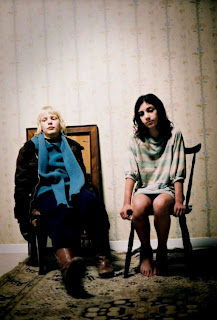
This month’s Audiodrome focuses on Johan Söderqvist’s chillingly beautiful score for Swedish vampire film Let The Right One In . Based on the book by John Ajvide Lindqvist, the story concerns Oscar, a lonely little boy, and his tentative relationship with Eli, an odd little girl who turns out to be a centuries old vampire. Söderqvist’s score gently chills the spine with icily subtle moments of terror, and thaws it out again with richly melancholy themes performed by the Slovak National Symphony Orchestra. It utilises spine-tingling sounds such as electric guitar played with a bow and a bass waterphone to eerily beautiful effect. Head over to Paracinema.net to read my full review and listen to an excerpt of the score. While you’re there, why not order yourself a copy of Paracinema issue 16 . There’s an abundance of in-depth articles on the likes of Ken Russell’s The Devils, Assault of the Killer Bimbos , found footage and mockumentary horror, disaster movies, French Science Fi...

Dark Mirror

Image
2007 Dir. Pablo Proenza When her family moves into a new home, photographer Deborah (Lisa Vidal) gradually begins to suspect sinister things are stirring from the house’s past. She catches glimpses of shadowy figures and doorways that aren't there in the mirrors and reflective surfaces. When she talks to her new neighbours she discovers that the previous owner, a famous artist, vanished in mysterious circumstances. Deborah is further convinced something evil lurks within the house as everyone she photographs dies in unnatural circumstances. Is Deborah experiencing a nervous breakdown? Or are there actually evil spirits trapped in the glass surfaces of her new home, waiting to pounce into our world? The mirror has featured heavily throughout horror cinema as a source of danger and fear. Mirrors are often used to address ideas of fractured identity, fear of one’s self, and psychological breakdown. A common visual motif in films in which someone is suffering from psychologica...

Ginger Snaps: Unleashed

Image
2004 Dir. Brett Sullivan Horror sequels can usually be a bone of contention with fans of the original. Often times sequels simply rehash the plot of the original, with an added emphasis on upping the gore quotient. They can sometimes reek of cashing in on the success of their predecessor and nothing more. It is a rare thing to find a horror sequel that not only matches the original film in terms of quality and originality, but that also opens up and continues the story with new ideas and something of its own to say. Ginger Snaps ended with Brigitte (Emily Perkins) putting her werewolf sister Ginger (Katherine Isabelle) out of her misery, but not before she was also infected with her lycanthropy. Brigitte had discovered a cure and when we last saw her she held salvation in her hand: a syringe of Monkshood (Wolfsbane). For all we knew she could have injected herself with it and went on her not-so-merry way. The film had a fairly closed ending that resolved its story nicely, thou...

The Flesh and Blood Show

Image
1972 Dir. Pete Walker A group of actors are menaced by a homicidal maniac as they rehearse a play in an old abandoned seaside theatre. When it comes to British horror cinema, writer/director/producer Pete Walker is often unfairly overlooked. Beginning his career making sexploitation movies, Walker would later progress to deliberately antagonistic, subversive and antiauthoritarian shockers such as Frightmare , House of Whipcord and House of Mortal Sin . Amongst the nudity and gore of these films were scathing social commentaries on British class, conservative politics and the legal system. Unapologetic, violent, exploitative, strangely thoughtful and always anti-establishment in their outlook, Walker’s later films were controversial, not only because of the extreme content, but also because of their reflection on the darker, seedier underbelly of British society. Walker’s first tentative venture into the horror/thriller arena came with Die Screaming Marianne , featuring Susan G...