
Shocks to the System
"Obviously what's happening in the world creeps into any work, it just fits right in. Because that's where it comes from, where the idea comes from, where you get the idea in the first place." George A. Romero

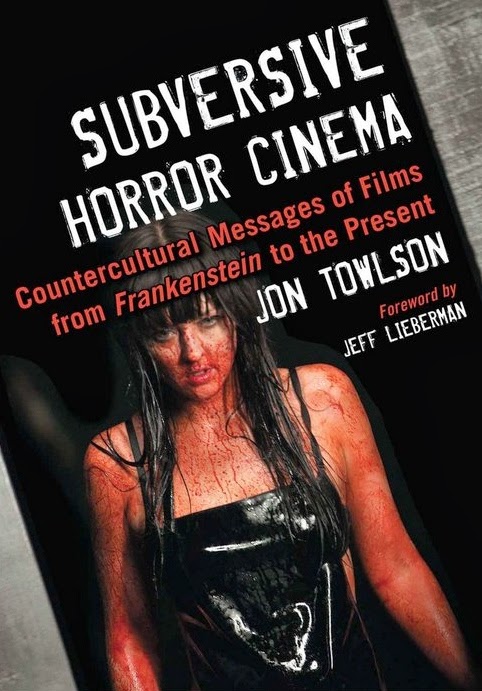
Horror cinema flourishes in times of ideological crisis and national trauma - the Great Depression, the Cold War, the Vietnam era, post-9/11. Subversive Horror Cinema: Countercultural Messages of Films from Frankenstein to the Present, a brand new book by Jon Towlson, argues that a succession of filmmakers working in horror - from James Whale to twisted twins Jen and Sylvia Soska - have used the genre, and the shock value it affords, to challenge the dominant ideologies of these times. Spanning the decades from the 1930s onwards, Subversive Horror Cinema is a critical examination of the work of producers and directors as varied as George A. Romero, Pete Walker, Michael Reeves, Herman Cohen, Wes Craven and Brian Yuzna - and the ways in which films like Frankenstein (1931), Cat People (1942), The Woman (2011) and American Mary (2012) can be considered "subversive."

Jon, a good friend of Behind the Couch, has written for Starburst Magazine, Paracinema, Exquisite Terror, The Irish Journal of Gothic and Horror Studies, Shadowland Magazine, Bright Lights Film Journal and Digital FilmMaker.

Subversive Horror Cinema: Countercultural Messages of Films from Frankenstein to the Present will be published in July 2014 by McFarland & Co, and is now available to pre-order. If you can’t wait that long, worry not, it is available to download for Kindle, no waiting necessary. For a detailed look at what it has to offer, including the delicious foreword by Jeff Lieberman (who, as the writer-director of titles such as Squirm, Blue Sunshine and Just Before Dawn, knows a thing or two about subversive cinema) check out the preview on Amazon.

Visit the author’s blog here, and keep up to date with him on Twitter and Facebook.

Popular posts from this blog

The Ash Tree

1975 Dir. Lawrence Gordon Clark Part of the BBC’s annual series A Ghost Story for Christmas , which ran from 1971 to 1978 and featured some of the small screen’s most chilling moments, The Ash Tree was the last of several MR James adaptations directed by Lawrence Gordon Clark. Written for television by David Rudkin, It stars Edward Petherbridge in the dual role of Sir Richard, an 18th century aristocrat who inherits the vast estate of his late uncle, and of Sir Matthew, his 17th century ancestor whose role in local witch trials, and the death of Ann Mothersole (Barbara Ewing), haunts Sir Richard.  With a slim running time (just over 30 minutes) The Ash Tree is one of the shortest entries in the series, but it is also one of the densest. The amount of detail and information packed in, without compromising or diluting the impact of the source material, is admirable. Clarke manages to convey events and flashbacks by utilising an interesting narrative structure and some ...

Mandrake (2022)

Mandrake tells of probation officer Cathy Madden (Deirdre Mullins), who is assigned to help with the rehabilitation of recently released ‘Bloody’ Mary Laidlaw (Derbhle Crotty), who had been incarcerated years prior for the murder of her abusive husband. Rumours have long swirled in the local area concerning Mary’s dabbling in witchcraft and involvement in cases of missing children. No sooner has she been released, than the bodies of several local children are found in the woods near her farmhouse. As Cathy and local police delve deeper, the veil between real and imagined starts to fray and Cathy is drawn into a dark world of occult ritualism and blood sacrifice. Directed by Lynne Davison and written by Matt Harvey, Mandrake is a delicious slice of witchy, Northern Irish folk horror, dripping with atmosphere and arcane lore. While Irish horror is having a moment right now, with acclaimed titles such as Aislinn Clarke’s Fréwaka and Kate Dolan’s You Are Not My Mother mining rich and cr...

Kensal Green Cemetery

During a recent visit to London, a friend and I decided to explore Kensal Green Cemetery in the west of the city. Founded as the General Cemetery of All Souls by barrister George Frederick Carden in 1833, Kensal Green was inspired by the garden-style cemetery of Pere-Lachaises in Paris. Comprised of 72 acres of beautiful grounds, it was not only the first commercial cemetery in London, but also the first of the ‘Magnificent Seven’ garden-style cemeteries established to house the dead of an ever-increasing population. Campaigners for burial reform were in favour of “detached cemeteries for the metropolis” and in 1832 Parliament passed a bill that led to the formation of the General Cemetery Company to oversee appropriate measures and procedures concerning “the interment of the dead.” The company purchased land for the establishment of Kensal Green in 1831 and held a competition in order to select an appropriate designer. Among the prerequisites in the brief provided to entrants, we...