Posts

Showing posts with the label Feminist Horror

The Ugly Stepsister (2025)

Image
Written and directed by Emilie Blichfeldt, The Ugly Stepsister filters the fairy tale of Cinderella through a feminist body-horror lens to lambast the impossible standards women are held to – both in this world and in folkloric fantasy worlds of make-believe. It follows Elvira (Lea Myren), a shy, awkward young woman who is driven by her mother, societal pressures, and by jealousy of her beautiful stepsister, to undergo gruesome cosmetic surgeries to make herself beautiful, win the heart of the prince and marry into wealth. Blichfeldt has created a daring work that blasts open the misogyny inherent in many literary fairy tales, revealing them to be a means of containing and controlling young women. Her screenplay ensures audiences glimpse the full horror of how glass slippers become glass ceilings, as female ambitions are forcibly limited, dreams corralled and bodies cruelly transformed. The film is laced with blood-dark humour as Blichfeldt sets about satirising and carving up patriar...

Ghouls on Film Zine

Image
Ghouls on Film is a Belfast-based feminist horror zine ‘for scream queens of all genders’, the contents of which aim to investigate the world of horror from a feminist perspective, ‘exploring how women can find agency in a genre that is traditionally male-dominated.’ Editor Isabella Koban, the founder and programmer of the local film society the zine takes its name from, organises screenings and events in the Black Box (an arts and performance space in Belfast's Cathedral Quarter). These events typically showcase underrepresented voices within the horror genre, both onscreen and from behind the camera, and contributors to the zine are largely comprised of women and non-binary folk. The first issue features an in-depth essay on the classic Stephen King adaptation Carrie (1976), a think-piece on horror networking events, book recommendations from Victoria Brown - founder of the Readers in the Rue Morgue horror book club - and an interview with Belfast drag artist King Phisher. Inspi...

She Will (2021)

Image
Aging actress Veronica Ghent travels with her nurse Desi to a remote wellness retreat in the Scottish Highlands to recover from a double mastectomy. The retreat stands upon the ground where thousands of women were persecuted as witches. As Veronica reflects upon her life – as a child star she was groomed and abused by a famous film director – she becomes aware of and begins to commune with powerful forces within the earth which enable her to exact revenge... She Will is the striking feature debut from artist and filmmaker Charlotte Colbert, who co-wrote the screenplay with Kitty Percy, and it unfurls as a bewitching amalgamation of atmospheric folk horror and MeToo-era feminist revenge fantasy. With her roots in the visual arts, Colbert effortlessly conjures an eerie atmosphere enhanced by a rich, stylised aesthetic and piercing imagery, backed by a pulsing Clint Mansell score. The film evokes an unnerving timeline of societal misogyny, paralleling past and present, from the emerging s...

The Substance (2024)

Image
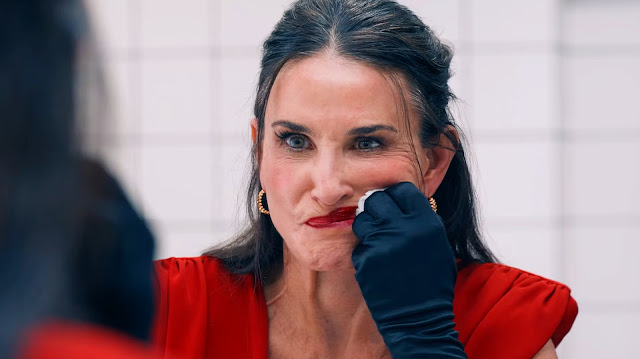
Written, directed, co-edited and produced by French filmmaker Coralie Fargeat, The Substance is a vicious and gruesome body-horror satire about ageing, identity and the impossible standards women are held to by a society obsessed with youth and beauty. It has divided critical opinion, with some lauding it as a feminist horror masterpiece, and others accusing it of pandering to the male gaze (those lingering shots of Sue's body in her fitted Lycra leotard), and exploiting old horror tropes (rendering the female body – especially older bodies - a source of terror). It tells of Elizabeth Sparkle (Demi Moore), a faded film star, who, on her 50th birthday, is fired from her hit aerobics TV show by her producer, who wants to replace her with a younger host. A despairing Elizabeth decides to try a new experimental drug that will create a younger replica of herself, with deeply horrifying results... When Elizabeth's replica, Sue (Margaret Qualley), finds success and fame as her replac...

Ginger Snaps Back: The Beginning (2004)

Image
1815. Ginger and Brigitte Fitzgerald, two orphaned teenaged sisters, seek refuge at an isolated trading fort in the snowy Canadian wilderness. They soon learn that the fort is under siege from werewolves lurking in the surrounding woods. After Ginger (Katharine Isabelle) is attacked and bitten by the lycanthropic son of the fort's factor, she begins to change. Her sister Brigitte (Emily Perkins) seeks a cure while trying to keep them both safe from the men in the fort, whose mistrust of the sisters is stoked by a bloodthirsty, wrathful minister. Directed by Grant Harvey, Ginger Snaps Back is a period piece (no pun intended) and a prequel to Ginger Snaps (2000), the story of a young woman who, on the night she first menstruates, is attacked by a werewolf and begins to transform into a monster. It was followed by  Ginger Snaps Unleashed (2004), which follows the plight of Ginger's sister, Brigitte, as she struggles to find a cure for her own latent lycanthropy. Written by Chr...

Raw (2016)

Image
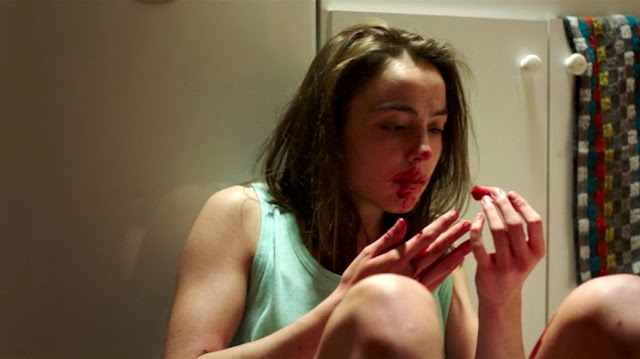
Written and directed by Julie Ducournau, Raw tells of veterinary student Justine (Garance Marillier), who is subjected to a series of humiliating and cruel initiations by the older students. Among the degrading rituals, Justine, a lifelong vegetarian, is forced to eat raw meat by her older sister Alexia (Ella Rumpf). This act awakens within Justine an insatiable bloodlust and craving for human flesh… Raw is an unsettling, full-blooded odyssey of self-discovery and actualisation told from a fiercely feminist vantage. It stalks similar territory to titles such as Ginger Snaps and The Company of Wolves in its unwavering exploration of female sexuality (which historically has been shamed or out-rightly denied by patriarchal discourse). Indeed, there are several irresistible parallels with  Ginger Snaps , not least the complex, often toxic bond between the sisters, and the intense cravings Justine experiences as her body reacts to her new appetites. And, like the Fitzgerald sisters,...

Amulet (2020)

Image
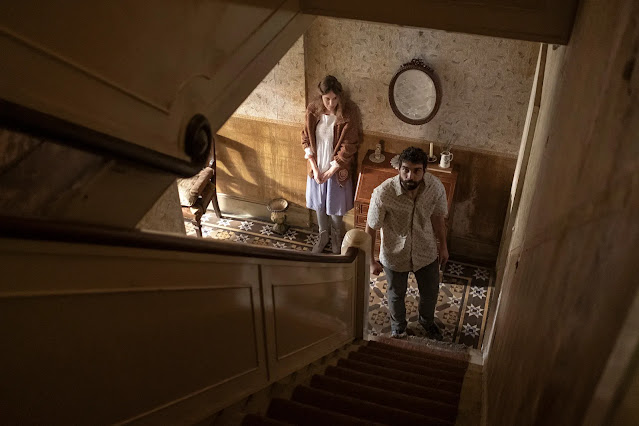
Written and directed by Romola Garai, Amulet tells of a troubled, displaced ex-soldier who is offered a place to stay at a decrepit old house in London, inhabited only by a young woman and her dying mother (who resides in the attic, no less). Before long, he begins to suspect something sinister is afoot... Flirting with various tropes from demonic possession and haunted house films (warnings to stay out of the attic, things heard moving in the walls, horrifying discoveries in the decaying plumbing), Garai masterfully sets the scene and creates a portentous, gloomy atmosphere before eventually lifting the curtain to reveal a truly original and terrifying fable of feminist revenge. With its exploration of forbidden spaces, depictions of the monstrous in its myriad forms and reflections on trauma, abuse and gender, Amulet is a highly unsettling and atmospheric work that wields a strange, undeniable power. Throughout, Garai maintains an insidiously creepy approach, her deliberate directi...

Black Christmas (2019)

Image
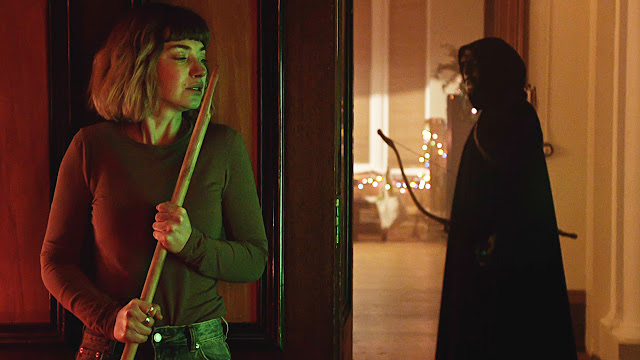
Many horror films have acted as a lens examining the societal issues, fears and anxieties of the times in which they were produced. As Jon Towlson notes in his book, Subversive Horror Cinema (2014), “Horror cinema flourishes in times of ideological crisis and national trauma - filmmakers working in horror - have used the genre, and the shock value it affords, to challenge the status quo during these times.” Written and directed by Sophia Takal, and co-written by April Wolfe, this loose remake of the classic 1974 slasher of the same name is a socially conscious horror which uses the American college sorority and fraternity systems as a microcosm to examine wider society’s current and historical misogyny. While the basic plot deviates considerably from the original, the tackling of the social issues which form the heart of the story does actually hark back to the original. While Black Christmas  (1974) is credited with helping to establish pre- Halloween slasher movie conventions, ...

Lucky (2020)

Image
Self-help author May (Brea Grant) is stalked and attacked in her home one night by a masked figure. The intruder returns to attack her again the following night. And again. And again. He returns, without fail, night after night. The authorities are unable to help and the people in May’s life appear weirdly indifferent. With no one to turn to, May is forced to take matters into her own hands to regain control of her life.  Written by and starring Brea Grant, and directed by Natasha Kermani, Lucky is not only a tightly wound chiller, it also serves as an arresting social commentary on violence against women; specifically attitudes to violence against women in wider society. Recent research disturbingly reveals there is a woman killed every three days in the UK. A news feature in The Guardian earlier this year described an ‘epidemic of violence against women’ in England and Wales, and said a radical shift was needed to address this deeply rooted problem and how police tackle these...

Jennifer’s Body (2009)

Image
A knowing blend of demonic-possession horror, teen comedy, rape-revenge narrative and coming of age satire, Jennifer’s Body tells of the complex friendship between two girls, one of whom becomes possessed by a succubus demon and begins devouring her male classmates. From its first line of dialogue, ‘Hell is a teenage girl’, it unravels as a razor-sharp and satirical dismantling of societal gender roles and stereotypes, sexual politics and an examination of the horrors and anxieties of growing up a young woman. Written by Diablo Cody and directed by Karyn Kusama, it plays with familiar tropes and offers something that still feels remarkably fresh. Indeed, since #MeToo and #TimesUp, its central themes are as relevant as ever.  At the heart of Cody's screenplay is an exploration of a complicated and toxic friendship. Jennifer (Megan Fox) and Needy (Amanda Seyfried) have been friends since they were children. There’s a strong co-dependency between them, the complexities of which becom...

Darlin’ (2019)

Image
Written and directed by Pollyanna McIntosh (a familiar face in horror having starred in titles such as White Settlers [2014], Tales of Halloween [2015] and The Walking Dead [2017-2018]), Darlin’ is a powerful, socially minded sequel to Lucky McKee’s 2011 film The Woman (which stared McIntosh as the formidable titular character). It picks up the story several years later, but also works well as a standalone film, as it follows the journey of a feral girl who is rehomed in a strict Catholic boarding school where a predatory bishop attempts to civilise her to gain publicity for his failing church. Meanwhile, the woman (McIntosh again, who resumes the role here with similar conviction) leaves a bloody trail of violence as she gradually tracks down her daughter, creating a further strand of tension. While McKee’s film depicted its protagonist being beaten and physically abused into submission and ‘civility’, with Darlin’ , McIntosh adopts a much more psychological approach in her explo...

Conversations About Wolves: Suzy McKee Charnas

Image
While conducting research for my forthcoming monograph on Neil Jordan’s The Company of Wolves , I had the pleasure of conversing with science-fiction and fantasy author Suzy McKee Charnas. Back in the late eighties Suzy wrote an award-winning short story called ‘Boobs’, which not only shares strong affinities with The Company of Wolves , but also preceded the thematically similar Ginger Snaps (2000) by over a decade. Like these titles, ‘Boobs’ connects the ambivalent figure of the adolescent girl, fluctuating between childhood and adulthood, with the figure of the werewolf, which fluctuates between human and beast, and draws parallels between menstruation, developing sexual identity and desire, and the unleashing of something wild. It tells of Kelsey, a shy and lonely teenager whose menarche coincides with her transformation into a wolf. She uses her new-found power and abilities to take revenge on a bully who has made her life a living hell and whose cruel nickname for Kelsey, due...

The Herd

Image
2014 Dir. Melanie Light The Herd is an unshirkingly brutal, vegan-minded short which serves as a chilling metaphor for the inhumane treatment of cattle at the hands of the dairy industry. Hundreds of millions of these sentient creatures suffer and die every year as their bodies are treated like machines. Forcefully impregnated so they produce milk, they are pumped full of growth hormones to produce unnaturally large quantities of milk, and antibiotics to combat constant mastitis infections. When they are no longer able to lactate, they are destroyed. The Herd substitutes women for cattle and subjects them to the same horrendous processes as the average dairy cow as it delves into the everyday horrors of the dairy industry… Head over to Exquisite Terror to read my full review .

A Woman Sobbing

Image
1972 Dir. Rodney Bennett A Woman Sobbing was part of the BBC’s Dead of Night horror anthology series from the early Seventies. Unfortunately not all of the episodes of the series have survived – three out of seven are all that is left, but they exemplify the series perfectly, capturing that unmistakably creepy and strangely nostalgic feel of ‘hide behind the couch’ television horror from yesteryear. A Woman Sobbing tells of Jane (Anna Massey), a middle aged woman who, after moving to the country with her family, begins to suspect that her home is haunted by a baleful spectre who ceaselessly weeps throughout the night in the attic room above Jane’s bed. Like many great ghost stories, the most haunting aspect of A Woman Sobbing is its ambiguity. Like most of the other episodes of the series, it unfurls as a study of psychological breakdown in modern society. Supernatural elements are present, but vaguely so. Jane may very well be haunted by a distraught ghost, but then again,...

Dark Mirror

Image
2007 Dir. Pablo Proenza When her family moves into a new home, photographer Deborah (Lisa Vidal) gradually begins to suspect sinister things are stirring from the house’s past. She catches glimpses of shadowy figures and doorways that aren't there in the mirrors and reflective surfaces. When she talks to her new neighbours she discovers that the previous owner, a famous artist, vanished in mysterious circumstances. Deborah is further convinced something evil lurks within the house as everyone she photographs dies in unnatural circumstances. Is Deborah experiencing a nervous breakdown? Or are there actually evil spirits trapped in the glass surfaces of her new home, waiting to pounce into our world? The mirror has featured heavily throughout horror cinema as a source of danger and fear. Mirrors are often used to address ideas of fractured identity, fear of one’s self, and psychological breakdown. A common visual motif in films in which someone is suffering from psychologica...