Posts

Showing posts with the label Giallo

Giallo Book Update

Image
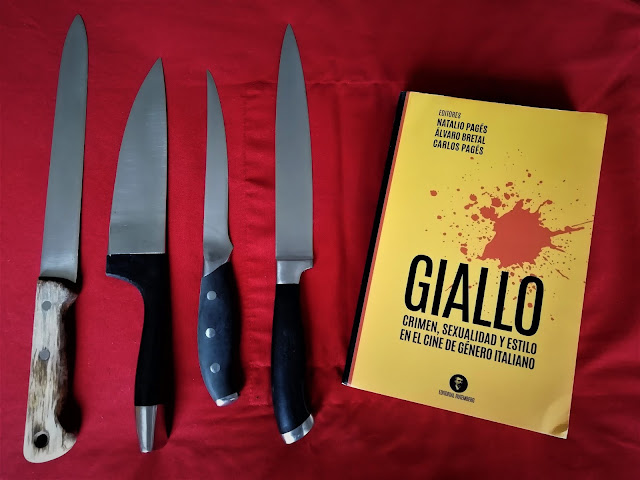
I have contributed to a new Spanish language book on Italian giallo films. Giallo: crimen sexualidad y estilo en el cine de género italiano ( Giallo: Crime, Sexuality and Style in Italian Genre Cinema ) is the latest publication from Buenos Aires-based Colectivo Rutemberg (Rutemberg Collective), a multidisciplinary group of artists, journalists, academics and writers dedicated to the creation of audio-visual and journalistic content. This publication, which features work from over 20 authors from Latin America and Europe, is particularly unique as it is the first ever Latin American book solely dedicated to Italian genre cinema, with a specific focus on the giallo. Edited by Natalio Pagés, Álvaro Bretal & Carlos Pagés, Giallo: crimen sexualidad y estilo en el cine de género italiano features content on many of the filmmakers who are renowned for their contributions to the giallo: there are essays on the work of Dario Argento, Sergio Martino, Lucio Fulci, Luciano Ercoli, Mar...

Giallo Book & Crowdfunding Project

Image
I have contributed an essay to a forthcoming book about Italian giallo films*. Giallo un libro sobre terror italiano ( Giallo: A Book about Italian Terror ) is the latest project from the Buenos Aires-based Colectivo Rutemberg (Rutemberg Collective), a multidisciplinary group of artists and writers dedicated to the creation of exciting audio-visual and journalistic content. This publication, which features work from over 20 authors from Latin America and Europe, is particularly unique as it will be the first ever Latin American book solely dedicated to Italian terror cinema. Exciting! With Giallo un libro sobre terror italiano , Colectivo Rutemberg will contribute to the dissemination and critical analysis of the giallo, which, at present, is the subject of a very limited bibliography in the Spanish language (the only other Spanish language book specifically dedicated to analysing the giallo was published in Spain in 2001 and is currently out of print). Giallo un libro sobre t...

Audiodrome #17: The Strange Vice of Mrs Wardh

Image
Barbara Steele, Daria Nicolodi and Edwige Fenech are but several women that spring to mind when contemplating Italian genre films. Moving behind the camera though, women are much less represented; in fact their presence is downright scant. There are however a few notable individuals who have proved they’re just as able to create cinematic shocks as the boys. One such woman is composer Nora Orlandi. Orlandi’s jazz-infused score for Sergio Martino’s dazzling giallo The Strange Vice of Mrs Wardh , enhances the decadent story, and mirrors the dark sensuality pulsing at the heart of it. Head over to Paracinema to read my review. While you’re there, why not pick up issue 19 of Paracinema Magazine. Inside you’ll find the likes of Aural Enigmas: Sound Design in Ti West’s The Innkeepers by Todd Garbarini, and  Corpse Fucking Art: A Guide to Necrophilia in Horror Cinema by Samm Deighan. It also includes my own feature, What’s In A Name? The Rise and Decline of Hollywood Fall Guy ...

The Night Evelyn Came Out of the Grave

Image
1971 Dir. Emilio P. Miraglia When Lord Alan Cunningham is released from a stint in a psychiatric hospital for murdering red-haired prostitutes who reminded him of his unfaithful late wife, he quickly remarries in an attempt to redeem himself. Once he and his new wife settle into the family home – a crumbling gothic mansion – a series of gruesome murders suggest his former wife has returned from the dead to wreck terrible revenge… The Night Evelyn Came Out of the Grave is one of several gialli from the early Seventies which exhibits unusual gothic influences. Alongside Sergio Martino’s Your Vice is a Locked Room and Only I Have the Key , Antonio Margheriti's Seven Deaths in the Cat’s Eye and Miraglia’s own The Red Queen Kills Seven Times , it boasts a moody gothic atmosphere, crumbling mansion setting, psychological deterioration, dysfunctional family melodrama and one of those ‘have-the-dead-come-back-to-haunt-the-living-or-is-someone-trying-to-drive-the-protagonist-insan...

Berberbian Sound Studio

Image
2011 Dir. Peter Strickland Peter Strickland’s sophomore film is a striking combination of dazzling Argento-esque style and haunting Lynchian atmosphere; it’s as though the director glimpsed into the collective mind-space of these filmmakers and recreated what he saw and heard there in this claustrophobic nightmare of sound and vision. Set in the Seventies, Berberbian Sound Studio tells of mild-mannered British sound technician Gilderoy (Toby Jones), who is brought to Italy to work on the sound effects for a gruesome horror film. His increasingly nightmarish task slowly begins to take its toll, and before long, life begins to imitate art. Or does it? From the opening moments, as Gilderoy is led into the studio – rather like a patient being led into a psychiatric hospital - an ominous dread seeps throughout proceedings and an ever dank ambiguity manifests itself. Alone in a foreign land, Gilderoy is completely ostracised by the rest of the crew as he spends his days recording ho...

All the Colours of the Dark

Image
1972 Dir. Sergio Martino When she loses her unborn baby in a car accident, a grieving woman becomes the target of a Satanic cult who may have been responsible for the death of her mother many years ago… Sergio Martino’s All the Colours of the Dark is a psychedelic trip of a giallo, filtered through the gothic aesthetics of Hammer Horror and the Satanic Panic-induced paranoia of Rosemary’s Baby . Reconceptualising the usual conventions of the giallo into a plot about a Satanic cult’s advances on a traumatised woman, it falls into a miniscule group of films critic Kim Newman dubs ‘giallo-fantastico’; gialli which boast overtly supernatural aspects as well as typical troupes such as sexual perversion, blackmail and murder. Adding to the delirious nature of the plot are abstract dream sequences and myriad moments which cunningly blur the line between reality and deranged fantasy. Jane (Edwige Fenech) has increasing panic attacks, hallucinations and nightmares which are woven into ...

Tulpa

Image
2012 Dir. Federico Zampaglione With his sophomore film Shadow , Federico Zampaglione – Italy’s sort of Rob Zombie – made a concerted bid to breathe new life into Italian horror cinema. While Shadow may have been more influenced by the current slew of ultra-violent ‘torture-porn’ films than Italy’s own distinct brand of bygone horror, it still emerged as an atmospheric and taut exercise in grim tension, with Zampaglione infusing it with enough of his own sensibilities to keep it surprisingly original. With follow up Tulpa , the director has attempted to create a contemporary giallo that is so faithful to its lineage it arguably borders on parody. Based on a story by Dardano Sacchetti, who wrote/co-wrote the likes of Cat O' Nine Tails (1971), Bay of Blood (1971), Schock (1981) and A Blade in the Dark (1983) amongst many others, Tulpa is the lurid tale of Lisa Boeri (Claudia Gerini), a respectable businesswoman who secretly frequents a private sex club to indulge her fanta...

30 Years On: Tenebrae Revisited

Image
Now regarded as one of Dario Argento’s most accomplished films, Tenebrae was originally met with critical hostility upon its release in the UK. It was heavily edited, relegated to the 'video nasty' list and eventually banned. The twisted tale of an American mystery thriller novelist who becomes caught up in a slew of sadistic murders, seemingly inspired by his latest book, the film was Argento's return to the giallo after the gothic fairy tale horrors of Suspiria (1977) and Inferno (1980). Head over to The Quietus to read my retrospective on the film, in which I discuss its origins, its initial reception, and how it has been subsequently revaluated as a self-reflexive commentary on not only Argento’s own body of work and the conventions of the Italian giallo, but on the alleged effects of violent entertainment on audiences. Happy Halloween! 

Paracinema 17

Image
Issue 17 of Paracinema Magazine is now available to pre-order. As ever, its packed to the gills with all manner of insightful and provocative articles and essays on genre cinema. Amongst the titles in this issue are “Endemic Madness”: Subversive 1930s Horror Cinema by Jon Towlson , You Can Clean Up the Mess, But Don’t Touch My Coffin: The Legacy of Sergio Corbucci’s Django by Ed Kurtz and I Don’t Want to See What I Hear: Paranoia and Personality Eradication in The Conversation by Todd Garbarini. Issue 17 also contains one of my own essays, an examination of the Gothic influences of Sergio Martino’s giallo Your Vice is a Locked Room and Only I Have the Key , titled Black Cats and Black Gloves.  Sound good? Head over to Paracinema.net to pre-order your copy now. Go on, support independent publishing.

Audiodrome #11 Your Vice Is A Locked Room And Only I Have The Key

Image
This month’s edition of Audiodrome focuses on Bruno Nicolai’s hauntingly beautiful score for Sergio Martino’s gothic-flavoured giallo, Your Vice Is A Locked Room And Only I Have The Key . Loosely adapted from Edgar Allan Poe’s The Black Cat , it stars Edwige Fenech as a scheming vixen, whose arrival at the crumbling villa of her alcoholic uncle seems to spark a slew of bloody murders. Nicolai's harpsichord-driven score eschews the usual jazz-inflected music associated with the giallo for something altogether more clandestine and melancholic, perfectly underpinning the macabre desires at the heart of the story. Head over to Paracinema.net to read my review and listen to a track.  While you’re there, why not pick up issue 16 of Paracinema Magazine . Amongst the abundance of articles and essays on genre cinema you’ll find the likes of Images of Horror and Lust in Ken Russell’s The Devils by Samm Deighan, The Films of René Laloux: Notes on the Golden Age of French Science Fic...

Interview with Ryan Haysom, Director of Neo-Giallo Short, 'Yellow'

Image
Italian giallo films are renowned for their brutal violence, dazzling style and convoluted ‘whodunit’ narratives. The combination of grind-house exploitation, art house aesthetics and bizarre fetishisation of violence, render the giallo a highly distinctive and unnerving cycle of films. The giallo is exclusively Italian and was initially popularized by Dario Argento’s The Bird with the Crystal Plumage . The films began to lose their commercial appeal in the late Seventies, but recent films such as Hélène Cattet and Bruno Forzani’s Amer , Guillem Morales’ Julia’s Eyes and Federico Zampaglione’s forthcoming Tulpa , to name but a few, highlight the overwhelming influence of the giallo on a new slew of international filmmakers. These ‘neo-gialli’ have sparked a resurgence of interest in the film cycle that looks set to continue with a new short film by Berlin-based filmmaker Ryan Haysom. Yellow is currently in production and looks set to draw heavily from the gialli of yesteryear, wit...

Audiodrome #6: Blood & Black Lace

Image
The latest instalment of Audiodrome: Music in Film is now up over at Paracinema.net . This month I check out Carlo Rustichelli’s rather swanky and often spooky score for Mario Bava’s ravishing giallo blueprint, Blood & Black Lace (1964). Infused with the sultry rhythms of the tango, Rustichelli’s music highlights the more sensual aspects of Bava’s lurid film about a sadistic killer preying upon the models of an elite fashion house. Skip on over to Paracinema to read it and listen to a track. While you’re there, why not think about ordering yourself a copy of the brand new issue of Paracinema Magazine. With articles such as When Life Gives You Razor Blades: Bloody Vengeance in Hobo with a Shotgun by Christine Makepeace; Revenge is a Dish Best Served Raw and Wriggling: Park Chan-Wook’s Vengeance Trilogy by Samm Deighan; Going Back Home: Post-Vietnam Masculinity in Rolling Thunder by Adam Blomquist and Chainsawing Well is the Best Revenge: Texas Chainsaw Massacre 2‘s Tex...

Talkin' Italian Horror

Image
When I was asked to have a chat about Italian horror films with Fred Macpherson from indie band Spector , I wasn’t going to say no. Any excuse to wax lyrical with a fellow admirer of Italo horror. An extremely enjoyable and geeky conversation about Argento and Fulci ensued. Head over to The Quietus to read it.

Tenebrae

Image
1982 Dir. Dario Argento After a detour into Gothic, witchy, fairy tale horror with Suspiria  (1977) and Inferno (1980),  Tenebrae  marked director Dario Argento's return to the gialli which he helped popularise in the early Seventies. Based on the filmmaker’s own experiences of an unhinged fan obsessed with his work, Tenebrae  is generally regarded as one of his finest films. It follows the story of American mystery-thriller novelist Peter Neal, whose arrival in Rome to promote his latest title coincides with a series of violent murders – the perpetrator of which claims to have been inspired by Neal’s latest book. When the author himself begins to receive death threats from the killer he must use his literary know-how to snare the slasher before he becomes the next victim. Unfolding as a cunningly reflexive critique of the Italian giallo, violence in cinema, and indeed Dario Argento’s own body of work, Tenebrae directly addresses the misogyny he has often...