Posts

Showing posts with the label Socio-Political Commentary

Diary of the Dead (2007)

Image
As the director of Night of the Living Dead (1968), George Romero will be remembered as one of the major pioneers of the modern horror film. A truly groundbreaking work, it was released just eight years after Hitchcock’s Psycho (1960), and like that film,  Night of the Living Dead similarly suggested that monsters can live right next door to us. Indeed, Romero took this notion one step further by suggesting that it is us who are the monsters. Several sequels followed, all of which provided socio-political commentary against the backdrop of a world where the dead return to life and consume the living, an examination of the human condition, and how ordinary people faced with extraordinary, unprecedented events struggle to survive. The horror in these films stems from the things people do to themselves and each other when the world as we know it comes shuddering to an end and humanity fragments and literally eats itself. Following on from Romero's previous Dead film, the am...

Under the Shadow (2016)

Image
Under the Shadow is the slow-burning and intensely creepy feature directorial debut of Iranian filmmaker Babak Anvari. It is ripe with socio-political commentary. And utterly terrifying. Utilising a culturally specific entity from Iranian mythology, Anvari confronts uncomfortable truths of certain cultural realities, particularly those experienced by women. By setting the story in Tehran during the Iran–Iraq War (1980–1988), when the city was repeatedly targeted by airstrikes in which thousands of civilians lost their lives, Anvari also addresses the traumatic realities faced by ordinary people living in a war-torn society. When her doctor husband is suddenly transferred to treat the injured at the frontlines, Shideh (Narges Rashidi) and her young daughter Dorsa (Avin Manshadi) remain at home. As missile attacks on the city occur almost daily, mother and daughter spend long periods of time in the bomb shelter beneath their building. Their relationship soon becomes strained as th...

Interview with Jon Towlson, Author of Subversive Horror Cinema

Image
Horror cinema flourishes in times of ideological crisis and national trauma - the Great Depression, the Cold War, Thatcher-era Britain, the Vietnam War, Western society post-9/11; since the dawn of the silver screen, the genre has held a mirror up to society, throwing back a shocking reflection to provoke and perturb huddled masses in darkened rooms; who more often than not, may see nothing but the horror of reality itself staring back at them from the screen. Subversive Horror Cinema: Countercultural Messages of Films from Frankenstein to the Present , a fascinating, meticulously researched and compellingly written new book by Jon Towlson, argues that a succession of filmmakers working in horror - from James Whale to twisted twins Jen and Sylvia Soska - have used the genre, and the shock value it affords, to challenge the dominant ideologies of these times. Jon recently took the time to have an in-depth chat with me about his new book, the subversive nature of horror cinema, and ...

The Exorcism

Image
1972 Dir. Don Taylor The Exorcism was part of the BBC’s Dead of Night horror anthology series from the early Seventies. Unfortunately not all of the episodes of the series have survived – three out of seven are all that is left, but they exemplify the series perfectly, capturing that unmistakably creepy and strangely nostalgic feel of ‘hide behind the couch’ television horror from yesteryear. The Exorcism tells of four friends who gather for Christmas dinner at a recently renovated old cottage in the English countryside. Throughout the evening a series of creepy occurrences suggest the spirits of the previous tenants do not rest in peace… The first episode to be broadcast, The Exorcism unfurls as a thoughtful critique of middle class attitudes and complacency, with several characters attempting to reconcile their wealth with their socialist upbringing. The juxtaposition between their fickle chit-chat, contemporary ‘concerns’ and bountiful Christmas spread, with that of the ...

Sleepwalker

Image
1984 Dir. Saxon Logan An evening of drunken debauchery, sexual rivalry and political debate turns bloody when a wealthy couple visit their friends, brother and sister Alex and Marion, in their decaying family home in the English countryside. A curious and highly effective blend of social satire, jagged political commentary and horror, Sleepwalker was thought lost for many years, with some doubting its very existence, it is so rare and obscure. Director Logan found it difficult to obtain distribution, partly because of the film’s running time (a trim and taut 50 minutes), partly because it’s so genre defying. Sleepwalker is incredibly atmospheric and eventually nightmarishly violent. The barbed points it makes on political life in Eighties’ Britain, many of which remain pressingly relevant, slice through to expose bare bone. The spiky dialogue is peppered with telling references to sleep disorders and serves to fuel the ambiguity of the narrative, whether it be through drool ...

Red State

Image
2011 Dir. Kevin Smith When three teenage friends answer an online invitation for sex, they are kidnapped by an extreme right-wing Christian cult who plan on punishing them for their ‘deviancy.’ The prospect of Kevin Smith addressing extreme Christian hate groups through the conventions of horror cinema is, for this writer anyway, an irresistible one. Smith already addressed the dangers of organised religion in Dogma , which, while rather plodding and uneven, was still an interesting departure for the director, famed for his lo-fi slacker-driven stories. While Red State may be a different beast entirely, it also sadly slides into unevenness of tone as the plot eventually crumbles under weighty speeches and a limp, exposition-heavy finale. Differing from the usual religious horror, the threat in Red State comes not from Satan or the occult, but from a fundamentalist right-wing Christian cult who believe their faith entitles them to carry out brutal acts of violence in the name...

The Sorcerers

Image
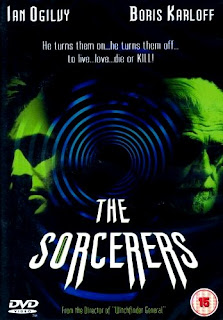
1967 Dir. Michael Reeves An ailing scientist and his wife create a device that enables them to control the mind of a young man and share the sensations of his physical experiences. It isn’t long though before the wife, drunk on power and obsessed with experiencing new things, begins to indulge her increasingly perverse desires, including murder. Reeves’ penultimate film is a curiously irresistible blend of horror and sci-fi, filtered through a cynical snapshot of swinging sixties London – and the moral vacuum of the characters – spiced up with various ‘mad scientist’ tropes. While it may be overshadowed by his last film The Witchfinder General , The Sorcerers exhibits as idiosyncratic and bleak an outlook on the corruptible nature of humanity as the Vincent Price starring classic. Both films peer into the depths of what causes normal people to do corrupt, despicable things, and due to its then-contemporary setting, The Sorcerers makes an especially powerful impact in this reg...

Maniac Cop

Image
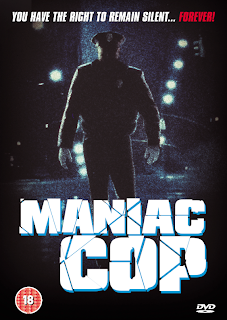
1988 Dir. William Lustig Innocent New Yorkers are being brutally murdered by a uniformed police officer. As the death toll mounts, officer Jack Forrest finds himself accused of the slaughter. With few friends, powerful enemies and a psychopathic slayer still at large, Jack teams up with hardboiled Detective Frank McCrae and fellow officer Theresa Mallory, to prove he’s not guilty and bring down the killer. You have the right to remain silent… Forever! Boasting a cult-tastic cast of 80’s exploitation veterans including Tom Atkins, Richard Roundtree, Bruce Campbell and Laurene Landon, Maniac Cop has so much going for it. The script, by Larry Cohen, coupled with William Lustig’s bruising direction, ensures the film unravels as an entertaining and riveting suspenser. Cohen has made a career out of subverting normal, everyday things into objects of terror: babies ( It’s Alive ), ice-cream ( The Stuff ), paramedics ( The Ambulance ), and public phone boxes ( Phone Booth ). Maniac ...

The Exterminator

Image
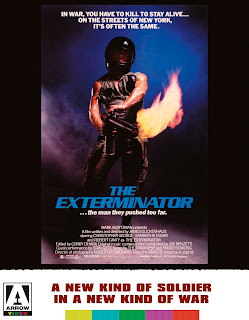
1980 Dir. James Glickenhaus After returning home to the US from fighting in Vietnam, a traumatised soldier attempting to rebuild his life turns vigilante when his best friend is paralysed by a group of thugs. While it may unfold as a brazenly violent, exploitative and at times trashy revenge fantasy, Glickenhaus’s The Exterminator is also at times a strangely thoughtful commentary on the difficulties of ex-military reintegration, post-war trauma and government corruption. The socio-political subtext about the plight of Vietnam vets and how their own society and justice system failed them on their return home, isn’t just a front for the exploitative violence – the film does make some genuinely stark points – some of which, particularly those about the ordinary working man’s dissatisfaction with greedy, corrupt governments who make us pay for their mistakes – have never been more prevalent. John Eastland (Robert Ginty) fought because he felt he would be protecting the ideals of ...