Funny Games

Dir. Michael Haneke
A middle class family are taken hostage in their holiday home by two young men who force them to play sadistic games for their own amusement.
Throughout Funny Games, director Michael Haneke strives to reawaken and stimulate audiences who have become accustomed to stylised cinematic violence and graphic imagery. The film not only assumes the form of a devastatingly cruel home-invasion narrative, but a scathing and darkly humorous critique on violence in modern cinema. Haneke explores, in typically cold and unrelenting fashion, contemporary audiences’ craving for violence and sadistic imagery, and the role we play when watching such films, forcing us think about how we interact with screen violence. It’s an isolating yet utterly involving film.
Working as a reflexive commentary on audience expectations and violence in cinema, and an exercise in unrelenting suspense, it exhibits an acute self awareness as it keenly subverts conventional notions of film-viewing. The constant interruption of the narrative – the antagonists frequently address the audience directly - ensures that we are always aware of our role as spectators and are forced to acknowledge and ponder our desire for violence. We’re frequently jerked out of the reality of the film to ponder, as objective observers, what is unfolding on screen. Given the plight of the family at the heart of this gruesome tale though, and how we inevitably side with them, remaining objective isn’t easy. We become accomplices to these brutal crimes and are reminded that the reason the young men are torturing the family is for our entertainment. During one instance we are even asked if we have ‘had enough?’
 |
| Funny Games 1997 |
 |
| Funny Games 2007 |
Relentless in its vision of brutality, the film questions the sensibility and motive of an audience who would pay to sit through such a display of human brutality and debasement. The two captors have a seemingly altruistic urge to provide the audience with everything we have come to expect from such a film - violence - as they directly address us as active spectators throughout. This implicates and renders us complicit in the crimes depicted in the film simply because we are watching it. As sophisticated as contemporary audiences believe themselves to be, it would be easy for us to predict how this particular grisly tale will play out; we’ve become so accustomed to watching violence on screen and have even become part of the very machinery that victimises the characters that populate horror films. It is as though we were helping to orchestrate their suffering instead of just anticipating it.
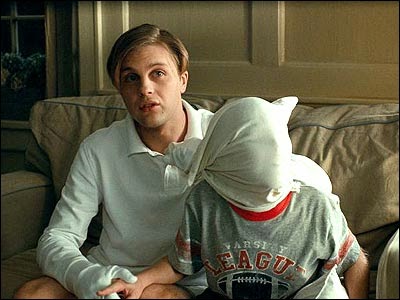
Through the ‘games’ the two men subject the family to in order to ‘entertain’ the audience, Haneke sets about awakening us to the senselessness of the increasing blood-lust that audiences display. He builds tension carefully and then completely obliterates it. Everything is filmed in long, static shots that not only serve to heighten the tension, but to create a clinical detachment. By seemingly giving us what we want, he just as suddenly takes it away – highlighted in one particularly manipulative scene involving a TV and a remote control... Interestingly, some of the aspects of reflexivity evident in Funny Games not only serve to remind us of our role as detached spectators, but also act as a tool with which to actively involve us in events, making it increasingly harder to remain objective. We are reminded that the plot is structured around the intention to entertain us and that the violence inflicted upon the family in the film is therefore our fault and carried out in our name.
 |
| Funny Games 1997 |
 |
| Funny Games 2007 |
Haneke acknowledges that voyeurism is an integral aspect of watching a film, but he then undercuts what he is acknowledging by not actually showing any acts of violence. Everything is left to the imagination of the audience, again forcing us to remain active within the events depicted in the film. Consistently subverting the conventions of the genre, Haneke provides no comforting answers. This is not a film where the villains’ backgrounds become a factor. Indeed, we learn nothing about them; not even their real names. They sometimes call each other Tom and Jerry - acceptable icons of violence - and when asked why they are humiliating and abusing the family, one of them offers various reasons which could have been plucked from any other psycho-thriller flick or media headline - ‘Is this virtual Neo-Nazi the sad product of divorce? An impoverished drug addict, perhaps?’ Haneke, a former student of psychology and philosophy at the university of Vienna, likens the villains’ behaviour and methods to those of a horror film director. ‘Why don’t you just kill us right away?’ the bruised and tear-stained woman asks her tormentors. ‘Don’t forget the entertainment value’ is the cold response. Audiences today have built up an overwhelming level of tolerance for screen violence. This was one of Haneke’s prime reasons for producing the film, and indeed directing its US shot for shot remake which lost none of its intensity or intentions in the process.
 |
| Funny Games 1997 |
 |
| Funny Games 2007 |
Haneke’s film simultaneously makes us aware of our role as a film audience, whilst forcing us to analyse why we watch violent films and what that may mean. However it also, rather contrarily, forces us to accept responsibility and provocatively points a finger at our desire to watch violent imagery and the part we play in its production. This results in a highly stimulating piece of cinema that is, while thought provoking and engaging, also extraordinarily challenging, accusatory, and daunting. Funny Games gives us space to contemplate our immunity to cinematic violence and degradation, and to perhaps reflect further what this bloodlust reveals about ourselves and the society in which we live.