Relic (2020)
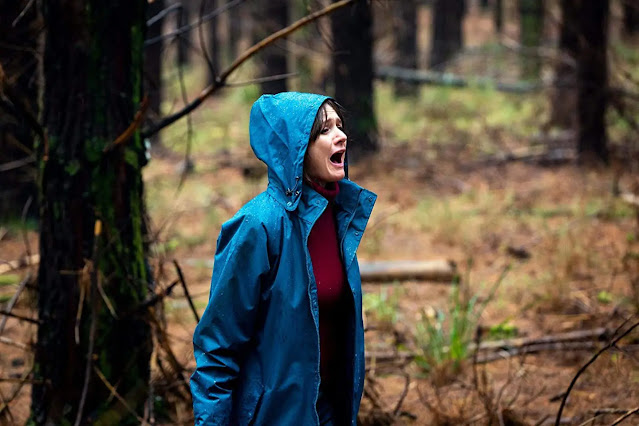
When Edna is reported missing, her daughter and granddaughter travel to the remote family home to search for her. They discover the house locked from the inside, strange noises from within the walls, and a black mould quietly spreading throughout. When Edna returns the next day, disorientated and bruised, unable to remember where she has been, and claiming someone has been coming into the house, her daughter Kay is convinced she can no longer take care of herself. Over the next few days, strange events, and Edna’s worsening condition, plunge the three women into a living nightmare.
With echoes of a ghost story, a haunted house film, a tale of possession, Relic is a terrifying and moving meditation on coming to terms with dementia and the gradual acceptance of decline and death. Written and directed by Natalie Erika James, and co-written by Christian White, its use of various tropes and images associated with haunted house films - an ominously overflowing bathtub, a lone figure standing in a dark room, rotten fruit, a strange black mould spreading across the walls – are chillingly utilised. However, James and White subtly deploy these images to connote indications of forgetfulness and the onset of Alzheimer’s. The house initially offers a cosy domesticity, with photos and trinkets telling of Edna’s life, of a family history. Post-it notes adorn much of the furniture and walls, with messages to remind Edna of certain things. These range from the mundane (‘brush teeth’), to the sad (‘I am loved’), to the downright creepy (‘don’t follow it’). As the story progresses, one character observes that ‘the house seems unfamiliar, bigger somehow’, and when granddaughter Sam (Bella Heathcote) discovers a part of the house she’s never seen before, her exploration of it becomes increasingly disturbing. Here Relic exhibits strong echoes of Shirley Jackson’s work, when it appears the house has a malevolent nature, deliberately confusing and taunting its inhabitants, whose fractured psychologies are what is actually haunted. When Sam becomes lost in the walls, these off-kilter moments perfectly convey a sense of disorientation, fading perception and loss of memory.
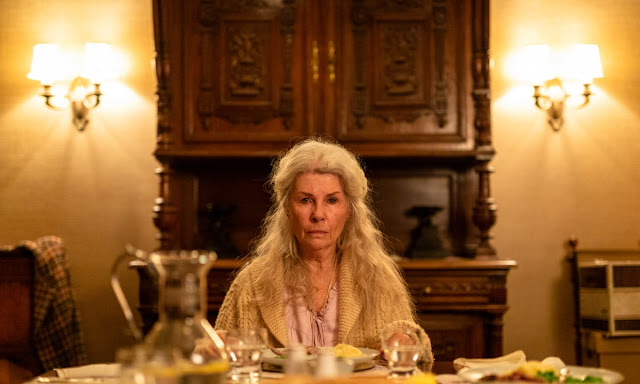
James’s subtle, suggestive approach fuels a powerful, slow-burning tension throughout. Is something supernatural haunting the family, or is it just something all too natural, something immensely tragic and sad that they have no control over? Edna (Robyn Nevin) insists someone is coming into the house, even hiding under her bed – doors are left open; things are moved around. Kay (Emily Mortimer) maintains her mother is just very forgetful, though after a while she wonders if there is some truth to her mother’s claims. She begins to dream of a horrifying discovery in the little cabin in the forest behind the house where her great-grandfather had lived, 'not properly taken care of'. The stained-glass window from this cabin is now in the front door of the house, and the way James films it, lingeringly, hints at a quiet ominousness harboured within the glass.
James and White’s screenplay taps into a powerful existential horror. We are all flesh and bone, but when our minds are taken by disease, how much of what remains is still us? This is the haunting at the heart of the story – Kay is haunted by memories of how her mother used to be, who she was. She is haunted by the spectre of dementia, which is gradually possessing her mother and rendering her unrecognisable. She exclaims ‘it’s not her anymore’ several times throughout, as though trying to justify moving her mother into a care home. This fusion of horror and pathos gives Relic its power, and this is especially conveyed in the scene where Kay follows Edna into the woods behind the house and finds her eating family photographs and attempting to bury a photo album, as though she were trying to protect and, literally, consume her memories.
Relic is a haunting, deeply unsettling exploration of the horror of watching a vulnerable parent deteriorate from the inside out, the horror and sadness of looking into the face of a loved one and not recognising who is looking back…