It Follows
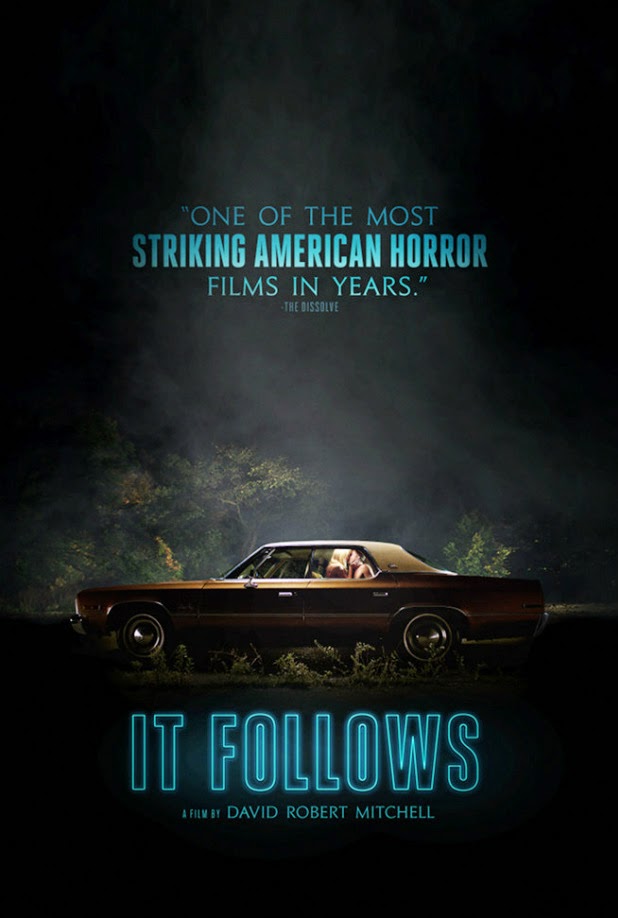
Dir. David Robert Mitchell
Like one, that on a lonesome road
Doth walk in fear and dread,
And having once turned round, walks on,
And turns no more his head;
Because he knows a frightful fiend
Doth close behind him tread - Samuel Taylor Coleridge
After Jay (Maika Monroe) and her boyfriend have sex, he tells her that he has passed a curse onto her and now something will begin to follow her. And when it catches up with her, it will kill her. Sure enough, she begins to experience an inescapable feeling that someone, or something, is after her…
It Follows is an insidiously creepy, yet beautifully produced shocker, moments of which will haunt you for some time afterwards. Blurring the line between sex and death, it taps into some very dark and primal fears indeed - abandonment, betrayal of loved ones, social ostracism. Most obviously it mines that very specific fear of being pursued so relentlessly by something unknowable, harmful and unreasoning; that unshakable fear that someone or something is creeping up behind you, getting closer and closer, until you can’t resist the urge and must turn and look… It also entrenches itself in the logic of grim and bloody fairy tales in which innocent youngsters are abandoned by parental figures to survive and figure out the ways of the world alone as they’re pursued by unspeakable evils salivating to do them harm.
The atmosphere of slow-mounting dread is evident from the beginning as a panicky opening scene immediately pulls us into the story and forcibly submerges us, breathless with tension, until a shock climax of horrifyingly grotesque imagery reveals what happens when the follower catches up to the followed. We never see what the girl is running from, only that she is terrified enough to run helplessly, half-dressed past her own father on the way to her car in an attempt to escape ‘something’ that gives the impression of being very close. Adding to the odd, ominous feeling throughout is the fact that much of the action takes place in daylight hours, and in places one would expect to find relative safety when being followed by someone or something unknown - buildings bustling with people, bland suburban streets at early dusk as neighbours arrive home from work or take the groceries out of their cars. It's this mix of mundane and otherworldly that imbues It Follows with much of its effectiveness.


Many horror films feature unsettling subtexts regarding sexuality and sexual angst - just look at the sex equals death conservatism of many 80's slashers. This forms the core of It Follows. A sexual act instigates untold terror when a curse is passed between lovers, and there’s a fascinating subtext concerning the dangers of casual sex and STDs and the increasingly harrowing effects they can have in today’s culture of cyber-bullying, sexual assaults going ‘viral’, victim-blaming tabloids and sexual shaming on social media platforms. Mitchell’s script carefully lingers on the moral implications of the situation as Jay agonises over whether or not she can bring herself to pass on her predicament to someone else. Her boyfriend assures her she’ll have no problems doing so as she’s ‘so pretty.’
Underpinning the fairy tale aspects is the almost complete absence of parental figures; Jay’s mother is often glimpsed around the house, but she is never shown to engage with her daughters. It isn’t necessarily an unloving relationship they have, as Jay and her sister seem protective of her - they discuss how telling her about certain things is not an option, she just couldn’t handle it. Her father is only depicted as a figure in a long-ago taken photo which suggests his absence - be it through death or divorce. The film is peppered with little subtleties such as this, which makes for a rich and immersive experience. The fractured family unit speaks of how a younger generation has had to grow up fast and learn to survive with little guidance or instruction, with peers substituting for absent parent figures.

 |
| Distinct echoes of Cat People (1942) as Jay is menaced in a swimming pool by an unseen presence |
Mitchell creates a subtle mythology around the otherworldly stalker. We know that only those who are cursed can see it, and that the curse is passed from one individual to another by sexual intercourse. The only way to escape is to pass the curse along to someone else. In an effort to catch up to them, the follower takes on the guise of people its victims know and love, but we never find out what it is, where it came from or even how it came to being. For all we know, it’s an ageless, timeless thing that has just always been following marked individuals across the globe. The influence of Halloween seeps throughout It Follows and like John Carpenter (and indeed the likes of Jacques Tourneur, Val Lewton and Robert Wise before them), Mitchell knows that the less his audience know about this unrelenting pursuer, the more sinister it is, the more power it wields over us and the more terrified the we are of it. HP Lovecraft said it best when he wrote “The oldest and strongest emotion of mankind is fear, and the oldest and strongest kind of fear is fear of the unknown.”


We glimpse it in various forms - some genuinely unsettling - but the most terrifying thing about it is its sole intention: to violently destroy whoever it is following. Its purposeful, measured pace ratchets up the tension and Mitchell utilises wide angled shots - again reminiscent of John Carpenter’s Halloween - to suggest the presence of something lurking in the shadowy periphery of the screen, watching, steadily approaching. Wraith-like camerawork enhances tension by gliding back and forth between the different viewpoints (and perceptions) of characters, and there’s an uneasy quietness to the composition of many shots. Danger isn’t heralded, it is gradually suggested and revealed.
As genuinely terrifying as it is, It Follows is also a film brimming with moments of exquisite, unselfconscious beauty. As mentioned, there are strong visual echoes of John Carpenter’s Halloween, with its quiet, suburban setting resplendent in the forlorn shades of autumn, and of Sofia Coppola’s The Virgin Suicides, with its ethereal, oddly dreamy atmosphere and frequently sun-dappled cinematography. Even the night scenes are lit with the familiar - and oddly comforting - orange glow of street lights. When things turn horrific and start to encroach upon this setting, the unsettling impact is undeniable. There is frequently striking imagery such as the girl sitting alone on a beach lit by her car headlights and the sprawling mass of blood in the swimming pool. The highly atmospheric score comes courtesy of Disasterpiece (Rich Vreeland) and segues between airy, Tangerine Dream-inspired prettiness, stark electronic drones which chill the back of the neck, and full-on panicked intensity.
A potent and perfect modern horror.


