The Spider Labyrinth

Dir. Gianfranco Giagni
A professor of languages working on a project translating ancient tablets from a pre-Christian religion travels to Budapest to find a colleague who has ceased communication, and return with his research. Shortly after he arrives, his ailing and strangely paranoid colleague is found dead. As the young professor delves deeper into the research, he finds himself increasingly entangled in a web of paranoia, grotesque murders and a bizarre cult determined to keep their existence a secret.
The Spider Labyrinth is an obscure oddity of Italian horror cinema. Made in the late Eighties, it manages to subvert expectations as it emerges as a curious entwinement of HP Lovecraft-inspired mythos, giallo trimmings, gothic horror atmospherics and occult conspiracy narratives, creating a highly moody and surprisingly gripping yarn.
While it may begin akin to the likes of such off-beat ‘conspiratorial’ gialli such as Short Night of Glass Dolls or House with the Laughing Windows, in which an outsider is drawn into a conspiracy with deadly and far reaching implications, The Spider Labyrinth later veers into more fantasy, creature-feature orientated horror. With a story revolving around a scholarly young man ensconced in the research of antique texts and artefacts that inevitably lead him to the discovery of some incomprehensively ancient and evil force that will threaten to shatter not only his belief system, but his very sanity, the film has a distinct HP Lovecraft vibe to it. The revelation that a secret and ancient cult known as The Weavers - whose gods are “not myths, but living creatures” and whose members will kill to keep their existence secret – also ushers events down a highly Lovecraftian route.


As an American in Eastern Europe, Professor Alan Whitmore (Roland Wybenga) is immediately rendered an outsider and it is during these scenes, and the way in which they build intrigue and suspense, that The Spider Labyrinth most resembles a fairly typical giallo narrative. Flashbacks of a traumatic event Whitman suffered as a child - when his friend locked him in a closet with a giant spider - also frequently pierce the narrative, lending proceedings a giallo-esque flavour. Whitmore’s ‘outsider’ status is highlighted by the way in which he is regarded with suspicion and outright contempt by various local types who all seem to know something he doesn't. While much of these moments are arguably clichéd, they still create a stifling atmosphere of paranoia and work to thicken the mystery surrounding uncommunicative colleague Professor Roth and the ancient texts he was researching. The marked contrast between the modernity of the university in Dallas, and the air of ancient traditions that linger foggily throughout the winding, empty streets of Budapest is effectively conveyed. It serves to highlight the hold the past has over the present in certain places, nourishing beliefs in ancient ways and practices. A particularly unnerving scene comes when Whitmore and his colleague’s research assistant Genevieve (Paola Rinaldi) have a drink at the hotel to calm themselves after the discovery of Roth’s body. Their hushed conversation draws the attention of everyone else in the dining room and an air of paranoia and unease abounds.
Giagni bides his time building a moody atmosphere and cranking up the tension, aided along the way with some darkly evocative conversations, such as the one between Whitmore and Mrs Kuhn (Stéphane Audran), the owner of the hotel. Woken up by screams in the night, Whitmore wanders through the dark and imposing building before happening upon a secret room where he finds Mrs Kuhn rocking an empty crib and pining for her dead child. They have a rather philosophical conversation about faith, God and mortality during which she intones: “God? There is no God. There is no light. There is nothing.”
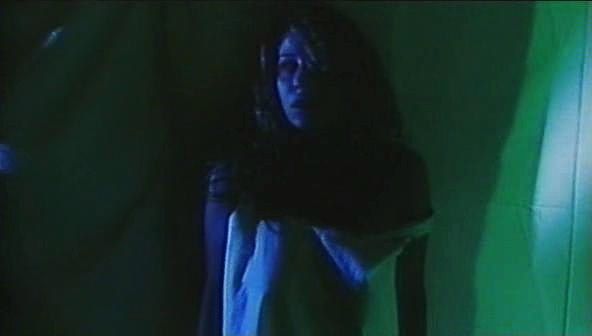

This fairly low-key approach picks up momentum and eventually goes all out crazy with the introduction of a be-fanged, frenziedly-haired hag who stalks and violently dispatches anyone who tries to help the professor, leaping upon her victims like a spider. In one memorable scene she stalks her victim from the ceiling above, entangling him in webs she salivates, lifting him up to her so she can slit his throat. As the pace picks up Giagni lets rip with some jaw-dropping creature effects - courtesy of Argento regular Sergio Stivaletti. These moments are arguably rather schlocky, but they still work within the context of the story and just add to the film’s already weird, off-kilter and quite frankly bonkers tone. Another suspenseful moment – and one that certainly provides a nod to Dario Argento - is the death of Marie (Claudia Muzi), a maid at the hotel who tries to warn Whitmore of the danger he’s in. Awakening in the night when someone whispers her name, she wanders through a vast, luridly green-lit laundry room with billowing white sheets everywhere, before being chased and stabbed in the head; her contorted, screaming face tightly pressed against a sheet she’s entangled in. The pièce de résistance must surely be the jaw-dropping climax that comes complete with a grotesque infant that mutates, courtesy of some squelchy The Thing-type effects, into a giant spider. Eek! The somewhat dated stop-motion spider effects also add to the increasingly delirious proceedings.

Giangi frequently doffs his hat to the likes of Argento and Bava throughout The Spider Labyrinth. Some of the scenes bear an uncanny resemblance to those in Argento’s Suspiria follow-up, Inferno; with characters wandering through a vast, formidable house in an almost dream-like state before being murdered in moodily lit set pieces. There’s also an interesting similarity in the appearance of Mrs Kuhn and Daria Nicolodi’s character in Inferno. Indeed, if you substitute the bizarre spider cult with the denizens of Mater Lachrymarum, you could well have another contender for a bona fide Three Mothers film, a la The Black Cat. The black ball that bounces into various shots just before someone is gruesomely dispatched echoes similar moments in Mario Bava’s deliciously gothic revenge-from-beyond-the-grave film, Kill Baby, Kill. While there are more than a few nods to the Masters, The Spider Labyrinth still unravels as an interesting and pretty unique film in its own right. It is also a very obscure film. The copy I watched was a VHS rip – complete with Japanese subtitles – courtesy of Midnight Video. For fans of Italian horror it is well worth seeking out, and one would hope that the likes of Shameless will one day give it a home on their label, lovingly restore it and allow it the chance to be seen by a wider audience.


