
Inch Abbey

While staying with friends in Ballykinler, County Down, last weekend, I paid a visit to the ruins of Inch Abbey outside Downpatrick. Looming out of a hollow betwixt two drumlins (from the Irish 'droimnín', meaning 'little ridge') on the north bank of the River Quoile, Inch Abbey was founded by John de Courcy in 1180. De Courcy was an Anglo-Norman knight who invaded Ireland in 1176. During his conquest he destroyed Erenagah Abbey, and in an attempt to atone for this act, he established Inch Abbey on the same site. The site on which Erenagah Abbey stood, and where the ruins of Inch Abbey still stand, was originally an island in the Quoile marshes, and was plundered by the Vikings in 1002 and 1149. Inch is the Anglicised word for 'inish', meaning 'island.'

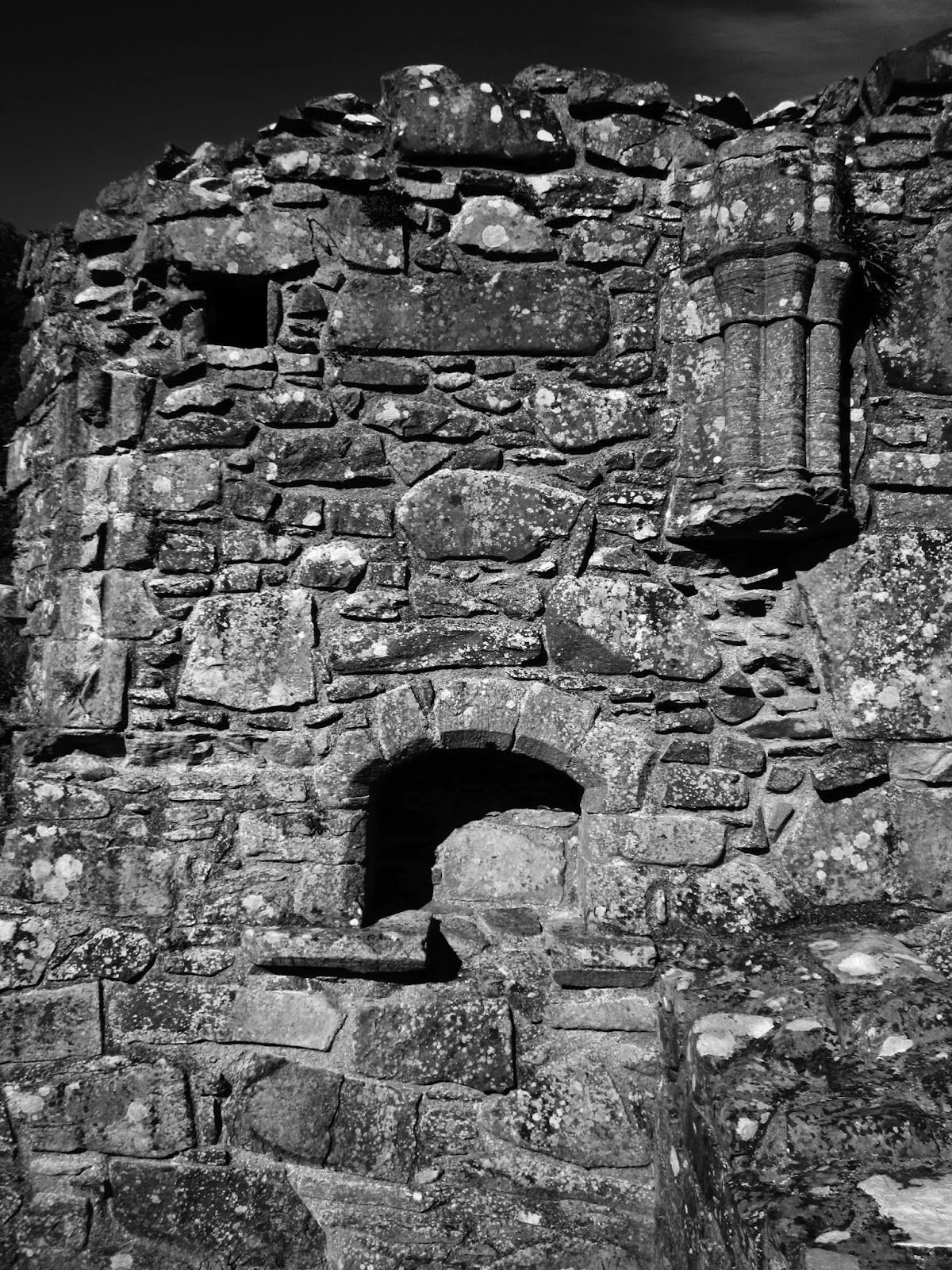
The layout of Inch Abbey is in the shape of a cruciform and the east wing, still standing today, features striking examples of early Gothic architecture - particularly the arched windows. Inch Abbey was inhabited by monks who came to Ireland from Furness Abbey in Lancashire, and they enforced strict laws that actually forbade the Irish from entering the abbey; in 1318 the monks were allegedly accused of hunting local people with spears in an attempt to keep them from straying too close to the Abbey.

Throughout the years there have been stories of odd occurrences around the Abbey, and many locals believe it is haunted. Spectral monks have been glimpsed in the mist as it rises over the banks of the river. It is thought there was once a causeway across the river, linking Inch Abbey to the Mound of Down, and there are various accounts from locals of shadowy figures seen moving in the mists offshore, as though walking on the surface of the dark water…




A View from a Hill: Down Cathedral as seen from Inch Abbey

The Parish Graveyard by Inch Abbey

In more recent times the Abbey and parts of the surrounding area have been featured as locations in Game of Thrones; most notably in series one and two when it provided the backdrop for ‘The Twins’, Walder Frey’s castles in the Riverlands. It is here that Lady Catelyn Stark learns of the execution of her husband Eddard and vows revenge...


While exploring the ruins, my friends and I encountered a local man walking his dog. He took pleasure in telling us about the time he was walking around the ruins in the ‘wee hours’ (very early morning, just after midnight) and came upon a child’s doll. As a joke he hid it in one of the windows of the tower but was chilled to the bone when, returning to the ruins the following night, he noticed the doll had moved and was now peering out of the window at him… He added that while he didn’t believe in spirits, spectres, fairies or 'little men', the place holds something of a creepy reputation amongst those who live nearby, and people avoid it after dark.

Popular posts from this blog

The Ash Tree

1975 Dir. Lawrence Gordon Clark Part of the BBC’s annual series A Ghost Story for Christmas , which ran from 1971 to 1978 and featured some of the small screen’s most chilling moments, The Ash Tree was the last of several MR James adaptations directed by Lawrence Gordon Clark. Written for television by David Rudkin, It stars Edward Petherbridge in the dual role of Sir Richard, an 18th century aristocrat who inherits the vast estate of his late uncle, and of Sir Matthew, his 17th century ancestor whose role in local witch trials, and the death of Ann Mothersole (Barbara Ewing), haunts Sir Richard.  With a slim running time (just over 30 minutes) The Ash Tree is one of the shortest entries in the series, but it is also one of the densest. The amount of detail and information packed in, without compromising or diluting the impact of the source material, is admirable. Clarke manages to convey events and flashbacks by utilising an interesting narrative structure and some ...

Mandrake (2022)

Mandrake tells of probation officer Cathy Madden (Deirdre Mullins), who is assigned to help with the rehabilitation of recently released ‘Bloody’ Mary Laidlaw (Derbhle Crotty), who had been incarcerated years prior for the murder of her abusive husband. Rumours have long swirled in the local area concerning Mary’s dabbling in witchcraft and involvement in cases of missing children. No sooner has she been released, than the bodies of several local children are found in the woods near her farmhouse. As Cathy and local police delve deeper, the veil between real and imagined starts to fray and Cathy is drawn into a dark world of occult ritualism and blood sacrifice. Directed by Lynne Davison and written by Matt Harvey, Mandrake is a delicious slice of witchy, Northern Irish folk horror, dripping with atmosphere and arcane lore. While Irish horror is having a moment right now, with acclaimed titles such as Aislinn Clarke’s Fréwaka and Kate Dolan’s You Are Not My Mother mining rich and cr...

Kensal Green Cemetery

During a recent visit to London, a friend and I decided to explore Kensal Green Cemetery in the west of the city. Founded as the General Cemetery of All Souls by barrister George Frederick Carden in 1833, Kensal Green was inspired by the garden-style cemetery of Pere-Lachaises in Paris. Comprised of 72 acres of beautiful grounds, it was not only the first commercial cemetery in London, but also the first of the ‘Magnificent Seven’ garden-style cemeteries established to house the dead of an ever-increasing population. Campaigners for burial reform were in favour of “detached cemeteries for the metropolis” and in 1832 Parliament passed a bill that led to the formation of the General Cemetery Company to oversee appropriate measures and procedures concerning “the interment of the dead.” The company purchased land for the establishment of Kensal Green in 1831 and held a competition in order to select an appropriate designer. Among the prerequisites in the brief provided to entrants, we...