The Company of Wolves Book Update

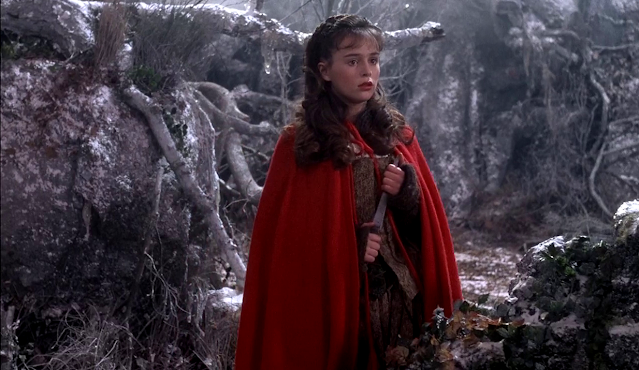
I’ve just submitted the final proofs of my monograph on The Company of Wolves (part of Auteur’s ‘Devil’s Advocates’ series), so it won’t be too long before it’s available to pre-order. I also wanted to share a preview of the beautiful cover design (right).

Here’s a little snippet from the intro:

The Company of Wolves is a dark fantasy film quite unlike any other. A meditation on the horrors of the adult world, and of adult sexuality, as glimpsed through the dreams of an adolescent girl, it amalgamates aspects of horror, the Female Gothic, fairy tales, werewolf films and coming of age parables. Drenched in atmosphere and an eerily sensual malaise, it boasts striking imagery immersed in fairy tale motifs and startling Freudian symbolism. 

The Company of Wolves was Irish filmmaker Neil Jordan’s second film, and his first foray into the realms of Gothic horror. Jordan co-wrote the screenplay with British novelist Angela Carter, and it is based upon several short stories from Carter’s The Bloody Chamber, a collection of reinterpreted classic literary fairy tales told from a piercing feminist perspective. 

The film incorporates elements from three stories - each a provocative reworking of Little Red Riding Hood: ‘The Werewolf’, which tells of how Red Riding Hood discovers her ailing Grandmother is actually a werewolf; ‘The Company of Wolves’, which begins as a series of folkloric anecdotes relating to werewolves, and ends with Red Riding Hood seducing a lycanthropic huntsman; and ‘Wolf-Alice’, the tale of a young girl raised by wolves who grows up outside the confines of civilised society and comes of age in the lonely castle of a werewolf duke.

Stay tuned for further updates.

Popular posts from this blog

The Ash Tree

1975 Dir. Lawrence Gordon Clark Part of the BBC’s annual series A Ghost Story for Christmas , which ran from 1971 to 1978 and featured some of the small screen’s most chilling moments, The Ash Tree was the last of several MR James adaptations directed by Lawrence Gordon Clark. Written for television by David Rudkin, It stars Edward Petherbridge in the dual role of Sir Richard, an 18th century aristocrat who inherits the vast estate of his late uncle, and of Sir Matthew, his 17th century ancestor whose role in local witch trials, and the death of Ann Mothersole (Barbara Ewing), haunts Sir Richard.  With a slim running time (just over 30 minutes) The Ash Tree is one of the shortest entries in the series, but it is also one of the densest. The amount of detail and information packed in, without compromising or diluting the impact of the source material, is admirable. Clarke manages to convey events and flashbacks by utilising an interesting narrative structure and some ...

Mandrake (2022)

Mandrake tells of probation officer Cathy Madden (Deirdre Mullins), who is assigned to help with the rehabilitation of recently released ‘Bloody’ Mary Laidlaw (Derbhle Crotty), who had been incarcerated years prior for the murder of her abusive husband. Rumours have long swirled in the local area concerning Mary’s dabbling in witchcraft and involvement in cases of missing children. No sooner has she been released, than the bodies of several local children are found in the woods near her farmhouse. As Cathy and local police delve deeper, the veil between real and imagined starts to fray and Cathy is drawn into a dark world of occult ritualism and blood sacrifice. Directed by Lynne Davison and written by Matt Harvey, Mandrake is a delicious slice of witchy, Northern Irish folk horror, dripping with atmosphere and arcane lore. While Irish horror is having a moment right now, with acclaimed titles such as Aislinn Clarke’s Fréwaka and Kate Dolan’s You Are Not My Mother mining rich and cr...

Kensal Green Cemetery

During a recent visit to London, a friend and I decided to explore Kensal Green Cemetery in the west of the city. Founded as the General Cemetery of All Souls by barrister George Frederick Carden in 1833, Kensal Green was inspired by the garden-style cemetery of Pere-Lachaises in Paris. Comprised of 72 acres of beautiful grounds, it was not only the first commercial cemetery in London, but also the first of the ‘Magnificent Seven’ garden-style cemeteries established to house the dead of an ever-increasing population. Campaigners for burial reform were in favour of “detached cemeteries for the metropolis” and in 1832 Parliament passed a bill that led to the formation of the General Cemetery Company to oversee appropriate measures and procedures concerning “the interment of the dead.” The company purchased land for the establishment of Kensal Green in 1831 and held a competition in order to select an appropriate designer. Among the prerequisites in the brief provided to entrants, we...