Posts

Showing posts with the label Sixties Horror

The Brain that Wouldn’t Die (1962)

Image
When surgical nurse Jan Compton is tragically killed in a car crash, her fiancĂ© Dr Bill Cortner retrieves her severed head and keeps it alive by means of highly unorthodox (!) and ethically iffy experiments. Despite Jan's protestations, he then sets out to find a suitable body for her, by any bloody means necessary… With its low budget, outrageous premise, and a lurid title promising all manner of exploitative thrills, the most shocking thing about The Brain That Wouldn’t Die is that it’s actually a deceptively thoughtful B-movie. Opening with a woman’s disembodied voice pleading ‘let me die, let me die’, the screenplay by Rex Carlton and director Joseph Green ruminates on some big and interesting ideas. While it can’t claim to be a feminist film, The Brain nonetheless has some feminist themes throughout it - such as bodily autonomy, patriarchal oppression, societal beauty standards and, perhaps most pointedly, the literal objectification of women. Other ideas thrown into the mix...

The Haunted Palace

Image
1963 Dir. Roger Corman While it takes its name from a poem by Edgar Allan Poe, The Haunted Palace is actually an adaptation of HP Lovecraft’s The Case of Charles Dexter Ward . It’s still regarded as one of the titles in Corman’s Poe cycle, not only because of its title, but because of its shared aesthetic, a gloomily literate script, unyieldingly grim atmosphere, preoccupation with death and mourning, and a household plagued by its dark secrets. There is also the presence of Vincent Price, a stalwart of Corman’s Poe adaptations. While the director had actually been keen to move away from Poe adaptations, he was persuaded not to buck the trend by producers, as their Poe films had been immensely successful. A compromise was reached - the film would be an adaptation of Lovecraft, but would take its title from a poem by Poe. It successfully entwines the themes and sensibilities of both writers and emerges as one of the best horror films made by Corman at this time. Lovecraft’s sto...

Die Monster Die

Image
1965 Dir. Daniel Haller Loosely based on HP Lovecraft’s short story The Colour Out of Space , Die Monster Die revolves around hunky All-American scientist Stephen Reinhart, who travels to England to visit the family home of his fiancĂ©, Susan Witley. He discovers the locals shun the Witley place and eventually happens upon the source of the family’s spooky reputation around town; Mr Witely (Boris Karloff) has hidden a luridly glowing meteor in his basement, and is using its radioactivity in hideous experiments on plant and animal life. Horrific consequences ensue, particularly when it becomes apparent the house’s occupants have been affected by the meteor too… When Lovecraft was writing The Colour Out of Space (1927) his intention was to fashion a story which dealt with something entirely outside of human experience or comprehension. The titular colour is eventually revealed to be a living entity and the horror Lovecraft weaves not only seeps out of the colour’s effect on the ...

Interview with Johnny Mains - Author/Editor of 'The Sorcerers by John Burke'

Image
In 1967 Michael Reeves directed The Sorcerers , a curious blend of horror and sci-fi in which Boris Karloff stars as an ailing scientist who creates a device that enables him to control the mind of a young man and share the sensations of his experiences. It isn’t long before the scientist’s wife, drunk on power and obsessed with experiencing new things, begins to indulge her increasingly perverse desires, including murder. The original story and screenplay was conceived and written by John Burke; however when Reeves and Tom Baker re-wrote sections of it at Karloff's behest, Burke’s credit as screenwriter was relegated to ‘Based on an idea by.’ This ‘error’ was eventually corrected in Benjamin Halligan's 2003 biography of Reeves. It is also the raison d’ĂŞtre for a new book by Johnny Mains, an award winning editor, biographer, horror film historian and renowned authority on the vintage horror anthology series, The Pan Book of Horror Stories . The Sorcerers by John Burke det...

Theatre of Death

Image
1967 Dir. Samuel Gallu AKA Blood Fiend The investigation into a number of grisly murders in which the victims bodies have been exsanguinated, leads detectives to a creepy Parisian theatre specialising in horror productions. Could someone at the theatre be responsible? No! Surely not ! Opening with a scene in which a woman is forced onto a guillotine and decapitated in front of an appreciative audience, only for her to emerge alive and well from behind the theatre curtain to accept her applause, Theatre of Death is intent on letting us know from the outset that all will not be as it seems. The lines between what is real and what is not twist and turn throughout proceedings. Setting the story in the real-life Theatre du Grand Guignol in Paris is an inspired choice. Between the years of 1897 and 1962 it specialised in the production of deliberately shocking and lurid plays, the raison d’ĂŞtre of which was to depict bloody scenes of murder and torture on stage to titillate and te...

The Mummy’s Shroud

Image
1967 Dir. John Gilling When a group of British archaeologists uncover the secret desert tomb of a child Pharaoh outside Cairo, they invoke an ancient curse and the murderous wrath of a mummy... If the above synopsis sounds familiar, that's because it is. The Mummy's Shroud boasts a typical mummy movie narrative in which a group of stuffy British archaeologists go snooping around in a Pharaoh's tomb and one by one are violently killed by a mummy - in this case, the faithful servant of the child prince whose burial place they desecrate. It was the third mummy movie made by Hammer. Director Gilling and writer Anthony Hinds don't really bring anything different or unusual to the tale, as it unravels (pun intended!) in the most stringently conventional way. Gilling's prior Hammer titles The Reptile and Plague of the Zombies were much more interesting, offbeat and effective horror films that at least tampered with convention and expectations. While the predicta...

Embodiment of Evil

Image
2008 Dir. JosĂ© Mojica Marins At the end of This Night I Shall Possess Your Corpse , the second Coffin Joe film, Joe (Mojica Marins) was cornered in a spooky swamp by torch-bearing villagers who’d had enough of his violent, misogynistic shenanigans. Denouncing God while laughing in their faces, Joe sank into the swamp and apparently drowned. Didn't he? Not so! As a flashback explains, he was pulled up out of the water again and imprisoned for his heinous crimes. 40 years later and he is eventually released from jail, and greeted on the outside by his faithful servant Bruno. How does Joe celebrate his freedom? Why, he goes in search of a woman 'worthy' of bearing him a child - and thus helping him obtain immortality by extending his bloodline! Cue much torture, bloodshed, nightmarish visions and a few familiar faces from the past, as JosĂ© Mojica Marins finally closes the long-awaited last chapter of his Coffin Joe Trilogy. Embodiment perfectly concludes At Midnight I...

This Night I Will Possess Your Corpse

Image
1967 Dir. JosĂ© Mojica Marins After the success of Coffin Joe’s first outing, At Midnight I’ll Take Your Soul , his creator JosĂ© Mojica Marins (who also portrays him onscreen) decided to resurrect him for further misadventures. This Night picks up straight after the events of At Midnight , as it is revealed that Joe didn’t actually die in the crypt, though he was severely wounded and traumatised by his ordeal. Soon after he is released from hospital and acquitted of his crimes due to lack of evidence, and he’s up to his old tricks again, kidnapping a slew of women and subjecting them to horrific tortures in order to find a woman 'worthy' of bearing him a child - and thus helping him obtain immortality by extending his bloodline.. Made four years after At Midnight , what is immediately obvious about This Night is how much Mojica Marins has honed his skills as a filmmaker. Technically speaking, this film is more accomplished than its predecessor, the script is tighter, th...

At Midnight I Will Take Your Soul

Image
1964 Dir. JosĂ© Mojica Marins ZĂ© do CaixĂŁo (that’s Coffin Joe to you and me) is something of a cult figure both in his native Brazil, and in the wider horror community. The creation of filmmaker JosĂ© Mojica Marins, who also portrays him onscreen, Coffin Joe has appeared in various TV anthologies, comics and sequels, as well as countless appearances in other films by the director. A nightmarishly striking figure - sporting long black cloak, top hat and grotesquely long fingernails - Joe first appeared in At Midnight I’ll Take Your Soul , which was also the first Brazilian horror film. A curious and carnivalesque oddity of a film, At Midnight follows the increasingly crazed exploits of undertaker Joe, as he attempts to find a woman 'worthy' of bearing him a child - and thus helping him obtain immortality by extending his bloodline. Addressing concepts such as faith, free will, social responsibility and politics, Marins’ film is an existential horror that unfolds with impi...

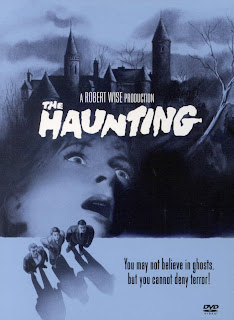
The Haunting

Image
1963 Dir. Robert Wise A parapsychologist seeking proof of the existence of the supernatural invites a select group of people to join him at the reputedly haunted Hill House. Once there, the group experience sinister events that not only threaten their sanity, but their very lives… Are these occurrences the result of a genuine haunting, or are they conjured by the unstable mind of one of the guests? Director Robert Wise was a protĂ©gĂ© of Val Lewton’s in the 1940s, and made his directorial debut on Lewton’s production of Mademoiselle Fifi , before working on the moody horror films Curse of the Cat People and The Body Snatcher . Shortly after he filmed West Side Story , Wise thought it high time he paid tribute to the man who gave him his start in the film business. In Shirley Jackson’s The Haunting of Hill House , Wise found the perfect blend of understated horror, fractured psychologies and icy atmospherics with which to pay homage to Lewton and the low key, suggestive horror of...