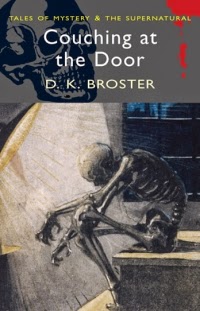
'Couching at the Door' by Dorothy Kathleen Broster
Suffusing her stories with the everyday and the mundane makes them all the more effective, and at times Broster approaches what can only be described as ‘kitchen-sink Gothic.’ Her protagonists are usually artists, or spinsters with an appreciation for fine art. Time and again she reveals her characters to have fallen on hard times, whether this be financially or through ill health. This renders them more vulnerable to experiencing the supernatural, or, as the case is certainly hinted at more than once, to believe they are experiencing something supernatural because of the psychological strain they are under. Sometimes the horror is so suggestive and grounded in the psychologies of Broster’s protagonists, it eludes classification, or indeed, explanation.
One of the weirder tales is the title story, which concerns Augustine Marchant, a writer of decadent and macabre literature which calls to mind works by M. P. Shiel and Robert W. Chambers, who is plagued by a black-furred serpent after he dabbles in mysterious and debauched activities in a house in Prague. The title is derived from an obscure passage in Genesis within which Marchant believes he has found an answer to his plight… “And if thou doest well, shalt thou not be accepted? And if thou doest not well, sin coucheth (lies, waits, crouches) at the door. And unto thee shall be his desire, and thou shalt rule over him.” When Marchant discovers how he can be free of this pest, he loses any sympathy the reader may have had for him… The sheer oddness of this story is enhanced by moments of flesh-crawling creepiness: “Wide awake in an instant, with an unspeakable anguish of premonition tearing through him, he felt, next moment, a light thud on the coverlet about the level of his knees. Something had arrived on the bed…”
The tales feature little to no violence, but when things do turn bloody, as they do in Clairvoyance, they are all the more effective because of Broster’s subtle approach. Clairvoyance tells of several well-to-do friends who gather for a séance tea-party one sunny afternoon. When a particularly sensitive member of the party becomes possessed by a former occupant of the house, the presence of an antique samurai sword in the drawing room where the séance is taking place, should leave you in no doubt as to the bloody fate of all involved… The Window, which is at times similarly gruesome, tells of a soldier who breaks into the long abandoned home of a woman he is obsessed with, in order to paint the view from the window. He becomes trapped and witnesses spectral bloodshed when the upper sash of the large window drops down on his arms. Broster works themes of destiny and sinister genealogical elements into the mix, with haunting results.
The Taste of Pomegranates is a highly unusual reworking of the myth of Persephone, featuring ‘growling, bloody-muzzled monsters’ that could be bears or troglodytes, menacing two archaeologist sisters trapped in a secluded cave. Here Broster taps into primitive fears such as the dark, or of being eaten alive, to weave a taut tale, moments of which evoke memories of The Descent, with their claustrophobic tension and subterranean terrors menacing untypical female characters.
Obsession is the main theme of The Promised Land and The Pavement – which has vague shades of the work of Arthur Machen, with its telling of an exhumed Roman villa, complete with highly curious mosaics depicting bucolic scenes and haunted maidens, and the effect they have on the elderly woman whose property they're discovered upon. The Promised Land, with its pitiful protagonist who is harassed into insanity and murder by an overbearing cousin while holidaying in Italy, recalls the obsessive and repressed female characters that walk (alone) throughout the chilling tales of Shirley Jackson. The denouement of this story is downright shocking in its simplicity.
Guilt and obsession also fuel the haunting in Juggernaut, a story that also demonstrates Broster's ability to have a little fun. The protagonist is a kindly author who writes macabre fiction under a pseudonym “fearing that if the vicar or some member of the Mother’s Union came upon her real name displayed upon the cover of 'The Murder Swamp', he or she might be scandalised.” Humour is also derived from her perpetual despair at the incompetency of her editor, who keeps making errors in the serialisation of her latest chiller, The Death Stairs – “the scoundrel has turned ‘the dreadful bond which linked them’ into ‘the dreadful bone which licked them.’” The author may be mild-mannered, but her love of the morbid and her "chronicling of deeds of terror had never affected her appetite, nor did the ‘Things’ which in her stories walked behind her heroes on lonely moors, or waited, gorilla-like, to strangle her heroines in underground passages, ever sit beside her bed or deprive her of a single night’s rest.” She’s a strong-willed and practical character, whose encounter with a seaside haunting (which calls to mind the work of MR James) is rendered all the more creepy because of her refusal to believe it is caused by anything other than guilt and obsession. Which it might be; Broster once again wraps things up with a healthy dose of ambiguity. The way she hints at the contents of the bath-chair is highly engrossing and quietly chilling. While the ending is clearly signposted, it is no less shocking because of Broster’s matter of fact and blunt execution.
One of the most peculiar and gripping stories is The Abyss. Here, Broster really mines lore and then-popular reports of doppelgangers, to eerie effect. The dark and light aspects of a single personality appear to be separated and take physical form after a horrific car crash. One of the passengers, Daphne, is “miraculously thrown clear” as the car plunges over a ravine. So where is she? When a young woman shows up claiming to be Daphne, why are there still reported sightings of her wandering along lonely roads? Is this a ghost? By suggesting that the self is not always housed within the body or the mind, and that it can sometimes detach itself and wander off as another being or entity, Broster explores some rather haunting notions and conjures truly creepy imagery; the two women waiting on the road by the mountain ravine, for example. Is something diabolical at play? Have the minds of the characters been shattered by grief? Broster offers no comfort.
For those who like their horror ambiguous and without satisfactory resolve, this collection of short stories will really be of interest.


