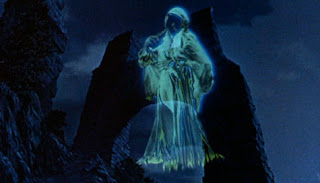
Color Out of Space (2019)

"There was something of stolid resignation about them all, as if they walked half in another world between lines of nameless guards to a certain and familiar doom." HP Lovecraft, Color Out of Space.
Adapted from a short story by HP Lovecraft, Color Out of Space is written by director Richard Stanley and author Scarlett Amaris. It marks the return of the cult director, whose last directorial feature was Dust Devil in 1992, though in the interim he has also directed documentaries, short films and written/doctored screenplays, including creepy doppelganger chiller, The Abandoned (2006).
There have been many filmic adaptions of Lovecraft’s work throughout the years, most notably from director Stuart Gordon, who proved quite deft in treading the line between the sort of pulpy exploitation and hallucinatory cosmic horror Lovecraft is renowned for. Lovecraft’s work has often been described as ‘unfilmable’ as his narratives tend to focus on conjuring atmosphere, and describing the dread and fear felt by his narrators. Many of his stories contain fairly simple plots built around the existential horror experienced by his characters (usually scholars, academics, researchers) whose meddling in forbidden texts throws into question everything held true about human existence, as inter-dimensional doorways are opened and all manner of unknowable cosmic horrors lumber/crawl/scuttle through into our world. Madness and death usually ensue, as characters realise the insignificance and inherent futility of human life, and various deities and Elder-Ones pierce the edges of our reality from the outer reaches of space and time. This bizarre pantheon of deities and abominations were described by the author in such a way as to sketch enough of a picture that allows readers to fill in the blanks with their own imaginations.
When Lovecraft wrote Color Out of Space in 1927, he was reacting to a then-popular depiction of alien life as humanoid, possessing human-like characteristics and traits. His intention was to create something truly alien and incomprehensible. The story, which also forms the basic plot of Stanley’s adaptation, is simple enough: an asteroid crashes onto the remote farm of a family and pollutes the water in their well. Gradually the plants and animal life around the farm, including the family, start to change. Crops grow abundantly and grotesquely large but are inedible. Animals “undergo loathsome changes which no one could explain” and “atrocious collapses or disintegrations were common.” Eventually the family members begin to go mad and one by one are either locked in the attic by the father, or go missing while retrieving water from the well.
In the opening scenes, Stanley creates and sustains a sense of foreboding as we’re introduced to the somewhat dysfunctional family who are already experiencing personal difficulties: the mother (Joely Richardson) is recovering from cancer, the father (Nicholas Cage) is struggling to make a success of his newly inherited farm, and the adolescent children (Madeleine Arthur and Brendan Meyer) resent the parents for the family’s relocation to the lonely farmstead (located "West of Arkham [where] the hills rise wild, and there are valleys with deep woods that no axe has ever cut"). An early piece of dialogue - "a dream you share is a reality" – works as a sinister foreshadowing of later events. When the meteorite crashes onto their land and strange things begin to happen, the atmosphere of dread steadily mounts as each family member begins to experience time and space differently. They become increasingly isolated and ripped apart, both literally and figuratively, as they are plunged into personal mindscapes from which they are unable to escape. All the while the landscape around the house becomes more otherworldly, as the alien presence takes hold and stifles everything under a hazy, heady atmosphere. As the story unfolds and the tone becomes more intense, Stanley launches into a full-on assault of the senses, with remarkable imagery and some truly gruesome body-horror moments. The film’s throbbing sound design and score come courtesy of Colin Stetson, who also provided the score and sound design for Ari Aster’s Hereditary (2018), another supremely creepy and upsetting film with a highly dysfunctional family at its bleak core.

While Color lacks the sort of dramatic impact Hereditary delivered (in keeping with the source material, characterisation is a little lacking), it certainly makes up for it with a visceral, sensory intensity. Nicholas Cage’s performance is as unhinged as one would expect, but frequently sits at odds with the tone Stanley is reaching for. Comparisons with Mandy (2018) will be inevitable as both films feature a crazed Cage performance, astounding, hallucinogenic imagery and characters whose lives are utterly consumed by outer forces, plunging them into psychotropic headspaces.
For hardcore Lovecraft fans, there are little nods to some of his other works to enjoy: daughter Lavinia is named after a character in The Dunwich Horror (1929), one character is seen holding a copy of Algernon Blackwood’s The Willows (1907), a story Lovecraft regarded as one of the finest horror stories ever written. Evocative witchy imagery in the opening scenes, as the daughter, a practising witch, casts protection spells for her mother, evokes memories of The Dreams in the Witch House (1933), and offers up the (undeveloped) idea of alternative belief systems and arcane ritualism.
Adaptations of Lovecraft’s work are often unfairly dismissed as critics claim they can never match the horrors evoked by the author’s prose so ‘what’s the point of trying?’ I would take a mediocre attempt over no attempts at all, and Stanley’s effort is one that really taps into the sort of primal, bleak horror Lovecraft excelled in; the sort of existential horror that devastates with the revelation that human existence is ultimately meaningless.
"The most merciful thing in the world, I think, is the inability of the human mind to correlate all its contents. We live on a placid island of ignorance in the midst of black seas of infinity, and it was not meant that we should voyage far. The sciences, each straining in its own direction, have hitherto harmed us little; but some day the piecing together of dissociated knowledge will open up such terrifying vistas of reality, and of our frightful position therein, that we shall either go mad from the revelation or flee from the light into the peace and safety of a new dark age." HP Lovecraft, The Call of Cthulhu (1928).