Women in Horror: Ida Lupino

Trailblazer Ida Lupino was to moody, suspenseful film noirs and taut thrillers in the 40’s and 50’s, as Jamie Lee Curtis was to slashers throughout the 80s. Born in 1918 and beginning her acting career in the 30s, Lupino starred in many noirs and thrillers such as They Drive By Night, The Hard Way and On Dangerous Ground. She eventually went on to become a pioneering figure amongst women behind the camera in cinema. She was the first American woman to ever direct a film noir (The Hitch-Hiker) and her other feature directorial offerings, such as Outrage and The Bigamist, were concerned with themes and ideas regarding social issues, sexual abuse and bigamy. No mean feat considering she was making films in a post Hayes Code Hollywood.

While her directorial offerings can’t really be described as straight ‘horror’, they still contain moments fraught with suspense, violence and unsettling moodiness, and she dabbled in hard boiled noirs and gritty B-movies. The Hitch-Hiker, one of Lupino’s most significant films, is about a couple of pals heading off to Mexico on a fishing trip who pick up a sinister hitchhiker along the way. Turns out, the mysterious stranger is a psychotic serial killer who casually reveals to the men in the car that he’s going to kill them when they reach their destination. In his book ‘Hollywood Directors’, writer Richard Koszarski praised Lupino’s film work, claiming “Her films display the obsessions and consistencies of a true auteur... Lupino was able to reduce the male to the same sort of dangerous, irrational force that women represented in most male-directed examples of Hollywood film noir.


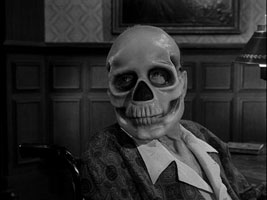
Later in her career, Lupino directed TV work, much of which was also genre based. She directed episodes for series such as Alfred Hitchcock Presents, Thriller, The Fugitive, Colombo and she was the first woman to ever direct an episode of The Twilight Zone. Lupino’s episode, The Masks, was part of the fourth series of the show. It's the nightmarish tale of a selfish family gathering together at the house of their ailing patriarch for a reading of his will. One of the stipulations of his will is that the family wear creepy masks that reflect their inner corruption. When it comes time to take the masks off, well, I’m sure you can guess that the story doesn’t end well…
Carrie Rickey wrote an article for the Village Voice, ‘Reel Women’ and in it she praised Lupino as a 'model of feminist moviemaking', stating “Not only did Lupino take control of production, direction and screenplay, but each of her movies addresses the brutal repercussions of sexuality, independence, and dependence.”

Lupino passed away in 1995 but her legacy, and her contribution to cinema remains, marking her as a highly daring, thoughtful and innovative filmmaker. 

Popular posts from this blog

The Ash Tree

1975 Dir. Lawrence Gordon Clark Part of the BBC’s annual series A Ghost Story for Christmas , which ran from 1971 to 1978 and featured some of the small screen’s most chilling moments, The Ash Tree was the last of several MR James adaptations directed by Lawrence Gordon Clark. Written for television by David Rudkin, It stars Edward Petherbridge in the dual role of Sir Richard, an 18th century aristocrat who inherits the vast estate of his late uncle, and of Sir Matthew, his 17th century ancestor whose role in local witch trials, and the death of Ann Mothersole (Barbara Ewing), haunts Sir Richard.  With a slim running time (just over 30 minutes) The Ash Tree is one of the shortest entries in the series, but it is also one of the densest. The amount of detail and information packed in, without compromising or diluting the impact of the source material, is admirable. Clarke manages to convey events and flashbacks by utilising an interesting narrative structure and some ...

Mandrake (2022)

Mandrake tells of probation officer Cathy Madden (Deirdre Mullins), who is assigned to help with the rehabilitation of recently released ‘Bloody’ Mary Laidlaw (Derbhle Crotty), who had been incarcerated years prior for the murder of her abusive husband. Rumours have long swirled in the local area concerning Mary’s dabbling in witchcraft and involvement in cases of missing children. No sooner has she been released, than the bodies of several local children are found in the woods near her farmhouse. As Cathy and local police delve deeper, the veil between real and imagined starts to fray and Cathy is drawn into a dark world of occult ritualism and blood sacrifice. Directed by Lynne Davison and written by Matt Harvey, Mandrake is a delicious slice of witchy, Northern Irish folk horror, dripping with atmosphere and arcane lore. While Irish horror is having a moment right now, with acclaimed titles such as Aislinn Clarke’s Fréwaka and Kate Dolan’s You Are Not My Mother mining rich and cr...

Kensal Green Cemetery

During a recent visit to London, a friend and I decided to explore Kensal Green Cemetery in the west of the city. Founded as the General Cemetery of All Souls by barrister George Frederick Carden in 1833, Kensal Green was inspired by the garden-style cemetery of Pere-Lachaises in Paris. Comprised of 72 acres of beautiful grounds, it was not only the first commercial cemetery in London, but also the first of the ‘Magnificent Seven’ garden-style cemeteries established to house the dead of an ever-increasing population. Campaigners for burial reform were in favour of “detached cemeteries for the metropolis” and in 1832 Parliament passed a bill that led to the formation of the General Cemetery Company to oversee appropriate measures and procedures concerning “the interment of the dead.” The company purchased land for the establishment of Kensal Green in 1831 and held a competition in order to select an appropriate designer. Among the prerequisites in the brief provided to entrants, we...