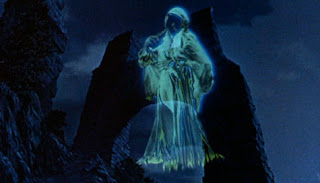
Cry of the Banshee

Dir. Gordon Hessler
In his attempts to purge his town-land of witchcraft and heresy, a tyrannical ‘n’ puritanical magistrate picks the wrong coven to mess with. After he massacres her followers, local witch Oona invokes a curse upon the magistrate’s family and before long, they are gruesomely picked off by a ravenous beastie…
Cry of the Banshee is an intriguing, highly atmospheric hybrid of occult and folk horror shenanigans and werewolf slasher flick (!). Hanging heavy with an eerie, doom-laden atmosphere, it revisits, and arguably rehashes, the story of Witchfinder General - made two years prior - in its tale of a merciless magistrate offing members of his community he believes to be guilty of witchcraft. It certainly revels in the same sadistic violence as its predecessor and boasts floggings, fiery brandings and characters burnt at the stake as witches. Opening with a young woman being forced to confess her involvement in the occult as the pious Lord Edward Whitman (Vincent Price) smirks down upon her from the bench in his court, Banshee musters a downbeat and grim tone. The onscreen murder of two Gypsy children follows soon after as Whitman entertains his upper class peers in his lavish home, openly demonstrating his sadistic leanings and contempt for the underclass.
What begins as a basic tale of witch-hunts and persecution soon veers into a ‘cursed family/creaky 'supernatural revenge’ narrative, with some werewolf movie traits thrown in for good measure. When Whitman kills local witch Oona’s (Elisabeth Bergner) followers, she curses his family and summons a ‘sidhee’ - a vengeful spirit/faerie/werewolf - which possesses the body of the family’s loyal stable-boy.


It’s a rather muddled affair and feels quite disjointed, as though the scripts for several different films had been spliced together. The uneven pacing is haphazardly broken up by some moments of atmospheric creepiness in which various victims are stalked and slain by the creature; the presence of which is signalled by a distant wailing attributed to a banshee. The monster is wisely relegated to the shadows, as the little we do glimpse of it reveals its cheap and cheerful make-up effects. The title of the film is a bit of a misnomer though, as the story doesn’t actually feature a banshee. What we do get is a curious blend of occult rituals and cod Irish mysticism that falls somewhere between Witchfinder General and Corman’s Poe films; it pillages Irish mythology with wild abandon and spuriously aligns itself with the writings of Edgar Allan Poe. While an excerpt from his poem The Bells appears onscreen before the animated opening titles roll, it is not actually based on anything written by Poe.


Vincent Price delivers a typically reliable performance as the evil judge - just imagine a much more melodramatic, theatrical rendition of Witchfinder General’s Matthew Hopkins and you’re halfway there - who gets his ghastly comeuppance in the twist ending; which is nicely realised. The script introduces way too many characters, far too early on - most of which just seem to get lost throughout the film - and this really bogs down the pace. Indeed, the only sympathetic characters are daughter Maureen (Hilary Heath), her prodigal brother, and her secret lover Roderick (Patrick Mower), who is also the unwitting werewolf/sidhee. The sumptuous production design of the magistrate’s abode cuts a striking juxtaposition with the poverty stricken village in which there lurks a muddy authenticity. Overall though, this lacks the grandeur of AIP’s earlier gothic (Poe inspired) horrors, and appears drab and bleak in comparison. One of the most exciting and unusual elements of the film is actually its opening credits. The cut-out animations were provided by none other than Terry Gilliam and they really pre-empt his work on Monty Python.


Cry of the Banshee unfurls as an entertaining occult-tinged creeper, with Mr Price doing what he does best and some creepily staged stalking sequences livening up the plodding pace and dialogue-heavy scenes.