Friday the 13th Part VII: The New Blood
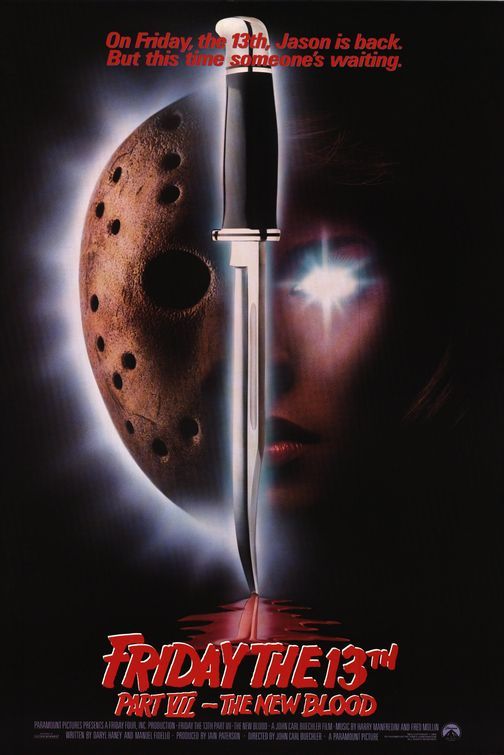
Dir. John Carl Buechler
Several years after Tommy Jarvis chained him underwater at Camp Crystal Lake, Jason Voorhees is accidently resurrected by a troubled young woman with psychic powers. It isn’t long before a group of teens staying in a house by the lake are murdered one by one by old Hockey Mask Face before a showdown with the telekinetic Tina ensues. Jason vs. Carrie, anyone?
"There's a legend around here. A killer buried, but NOT dead. A curse on Crystal Lake, a death curse. Jason Voorhees' curse. They say he died as a boy, but he keeps coming back. Few have seen him and lived. Some have even tried to stop him. NO ONE can."
The New Blood originally started out as Freddy vs. Jason, but neither New Line nor Paramount could come to any agreement about how to bring this clash of the slasher titans to the big screen. It would take many years for this film to be produced. There’s no doubt though that Part VII was heavily inspired by the success of A Nightmare on Elm Street and that series’ special effects sequences. The New Blood unspools as a violent fantasy horror exhibiting overtly supernatural trimmings; Jason is firmly established as an unstoppable killing machine and Tina (Lar Park-Lincoln), a young woman with latent telekinesis, is the Final Girl who must do battle with him using her resourcefulness and special psychic gift.


Writers Manuel Fidello and Daryl Haney stick rigidly to the formula – even going as far as copying the basic structure of Part IV: the resurrected Jason terrorising a lakeside house full of teens next door to a house homing a troubled family. The characters are, again, painted with the broadest of strokes, with the merest distinguishing characteristics. One of them is an aspiring sci-fi writer. They have come together for a birthday party or something, while in the house next door, Tina, her mother and her psychiatrist – the dastardly Dr Crewes – try to help Tina deal with her traumatic past (she caused the death of her abusive father by drowning him in Crystal Lake with her telekinetic powers). Wracked with guilt and with the dastardly Dr Crewes spurning her on (for his own dastardly gain), she attempts to raise her father from the murky depths of the lake, only to inadvertently resurrect the dormant corpse of Jason instead. He immediately sets about chopping up the teens next door and eventually Tina’s mother and a whole other group of friends camping in the area.
1. Psychology. The illusion of having previously experienced something actually being encountered for the first time.
2. Disagreeable familiarity or sameness: The new television season had a sense of déjà vu about it—the same old plots and characters with new names.
Origin: 1900–05; < F: lit., already seen.


The New Blood suffered at the hands of the censors who deemed the violence much too outlandish and brutal for cinema audiences, particularly the scene in which the dastardly Dr Crewes is killed when Jason sticks a whirring hedge trimmer into his chest… Also featured in The New Blood is perhaps one of the most infamous death scenes in the whole series: an unfortunate camper inside a sleeping bag is repeatedly bashed against a tree by Jason. Elsewhere the methods of inducing violent death consist of head-crushing, neck slashing, impaling, stabbing, skewering and the obligatory chucking people through a window. Director John Carl Buechler was also responsible for creating the SFX and he'd previously helmed and created special effects for films such as Troll and Cellar Dweller. He would go on to provide effects and make-up for the likes of Ghoulies, A Nightmare on Elm Stret 4: The Dream Master and erm, Slave Girls From Beyond Infinity, amongst others.


As before, characters wander around, not even noticing their dwindling numbers, wafting out into the night to search for lost earrings/investigate strange noises/get something from the car. Whatever. Jason pops up out of nowhere and violently offs them. Tension is a distant memory. From a whole other movie. The New Blood is unintentionally hilarious, and one of the campest entries in the series (which is no bad thing at this rate), the bouffant hairstyles, shoulder pads and sassy dialogue adding to the entertainment value. One creepy and strangely subtle moment does come however, when one of the characters enters the darkened kitchen for a midnight snack. When the lightning flashes, the hulking form of Jason is briefly glimpsed standing stock still in the corner of the room waiting to pounce. The moment is uncharacteristically subtle for the series, and indeed the rest of the film – which exhibits about as much subtlety as the director’s initials would suggest…


According to Peter M. Bracke's book, Crystal Lake Memories, behind the scenes the film was nicknamed Fri-Gay the 13th, as many of the cast and crew were gay, bi and lesbian. Apparently there were some tense stand offs between the cast and crew and some homophobic locals in a bar near the set. The film is lent a strange mood because of the setting - it was filmed in Alabama (which may explain the repugnant homophobia the cast and crew encountered) – as far removed from the lush greenery of the original Camp Crystal Lake as you can get. Weird mosses and roots evoke an oddly American Gothic atmosphere and Crystal Lake is more like a swampy bijou than idyllic leafy summer camp. The New Blood is also significant because it was the first film in the series to feature Kane Hodder, the only actor to play the role of Jason more than once. Most other actors only portrayed the hefty killer once, whereas Hodder embraced the iconic role.

1988 not only saw this, the seventh title in the Friday the 13th series hit cinemas, but also saw the series produce its own spin-off TV show. The premise of the show, also called Friday the 13th, revolved around a couple of cousins who inherit an old antiques shop, only to discover all of the items have been cursed by the devil. They spend three series retrieving all the items and experiencing all manner of diabolical shenanigans. The show went some way to influence the likes of The X-Files and Buffy the Vampire Slayer and while it didn’t actually feature Jason, there were plans at one stage to create an episode based around a cursed hockey mask that would eventually find its way to a familiar owner…


